Week 3: Japan & Korea...Are They The Same?
- kelafoy
- Aug 31, 2022
- 9 min read
Updated: Sep 7, 2022
Introduction
Week three is focused on Japan and Korea. Although close together on the map, the two neighboring countries couldn’t be more different in terms of cuisine.
“It is said that the important things in cooking Japanese food are Gomi (the Five tastes), Gokan (the Five senses), Goshiki (the Five colors) and Goho (the Five cooking methods).” (Washoku, 2022)
“Korea has developed a unique food culture connected to its long agricultural history. Recently, interest in Korean food, especially regarding its health benefits, has greatly increased. However, there are insufficient resources and research available on the characteristics and definitions of Korean cuisine.” (Journal of Ethnic Foods, 2016)
I did a TON of research this week for these two countries. Be patient with me, as this blog post is longer than normal. I think you’ll be pleasantly informed by the time you finish, and it will be worth the time it takes to read it all. Happy learning friends! 😊
Method of Cookery:
“Japanese cooking can be broken down in to five basic cooking methods. These are "Nama"(cutting), "Niru" (simmering), "Yaku" (grilling), "Musu" (steaming) and "Ageru" (deep-frying). In standard Kaiseki-style cuisine (a traditional Japanese course dinner), these five ways are all incorporated, found usually as "Nama (cutting)" sashimi, "Niru" simmered dishes, "Yaku" grilled dishes, "Musu" steamed dishes, and "Ageru" deep-fried dishes.” (Washoku, 2022)
“As traditionally baking or frying were not common cooking methods, Koreans tended to use fermenting, boiling, blanching, seasoning, and pickling. Among these methods, the most characteristic method is fermentation. The process of fermentation enriches food flavors and preserves foods.” (Journal of Ethnic Foods, 2016)
Prior Knowledge of the Dish:
I don’t know much about the cuisine from either of these regions, other than the fact that I like to eat it. 😊 My stepfather made kimchi regularly when I was growing up. You could always find a mason jar full on the top shelf of our refrigerator. As a kid, it was entirely too spicy for my taste. As an adult however, I do love a good kick with my meal. I am super excited to work on sushi this week. I could eat sushi 7 days a week and probably never tire of it. I wonder if it’s possible to combine the two regions and create a kimchi sushi? Now that’s a flavor combination I can totally get down with!
Learning Objectives:
· Introduce the histories of Japan and Korea, each country’s geography, cultural influences, and climate.
· Introduce Japanese and Korean culinary culture, their regional variations, and dining etiquette.
· Discuss the influences of Japanese and Korean cuisines on each other and their differences and similarities.
· Identify major aesthetic, philosophical, and religious influences
· Identify Japanese and Korean foods, flavor foundations, seasoning devices, and favored cooking techniques.
· Offer the major dishes of Japan and Korea through techniques and recipes.
Background Information
Origin & History:
Japan
“One of the first things you notice about a Japanese meal is that traditionally all the different elements are separated into small dishes. It used to be considered bad form to have all the food in one bowl or on one plate! This is a dining style that originated in the Kamakura period, and it was mainly adopted from the classical Chinese style of serving food, as well as the way Buddhist tea ceremony is served… historical deviation from the idea that the Japanese have always eaten fish and rice, is that fact that although rice has always been popular, wheat was actually the staple grain in northern areas of Honshu and Hokkaido during the 1800s. Prior to infrastructure, rice was difficult and expensive to import from the areas where it grew best. In history peasants often blended their rice with millet for a more substantial, energy-rich dish.” (SushiSushi, 2015)
Korea
“For many centuries China dominated East Asia's culture. Writing, governmental systems, arts and foods that evolved in China were passed on to Korea and then to Japan. Korean food is also heavily influenced by the revolutionary changes in world cuisines that occurred after 1500 A.D. The European conquest of the Americas led to a world-wide distribution of new foodstuffs. The best example for Korea is the chile. A native to Central and South America, it was spread across the world by Portuguese and Spanish merchants. Indian and Southeast Asian cuisines without chiles are unimaginable. Nor is Korean. Chile paste are absolute staples of all Korean tables and many food preparations. Although many people think of Korean cuisine as "hot", in reality chile sauces are not loaded onto every dish but added as flavor enhancements.” (Education Planet, 2022)
Methods Used:
Japan
“Gomi (The Five tastes)
Gomi refers to the five tastes of "Sweetness", "Sourness", "Saltiness", "Bitterness" and "Umami". We experience just one taste when we eat something sweet, sour or salty, but there are differences in tastes when it comes to bitter foods. For example, the bitterness of chocolate and the bitterness of an onion are something quite different. Then, the fifth taste, Umami, typically includes glutamic acid, found in kombu kelp, but the taste can also be extracted from dried bonito, dried shiitake mushrooms, and shellfish. Umami is also the principle taste of dashi broth, which is an indispensable ingredient in Japanese cooking.
Goshiki (The Five Colors)
In the preparation and plating of Japanese cuisine, special emphasis is placed on the use of five colors. Those colors are red, yellow, blue (green), white and black, and are used to express the excellence of Japanese cuisine. It is said that red and yellow are warming colors that stimulate the appetite, while blue evokes a refreshed feeling, white a feeling of cleanliness, and black creates sharp contrast in the whole. When serving, food is plated in consideration of the dish colors, and the five colors are incorporated further through visual elements, including decorative leaves and flowers. These enhance the visual appeal of the food and make the meal more enjoyable.
Gokan (The Five Senses)
Gokan refers to the five senses of "Sight", "Hearing", "Smell", "Touch”, and "Taste". These five senses help us to recognize how delicious something is. It is important to understand that eating is not only a taste experience but is something that we partake in with all five senses; we use sight to notice how physically attractive the food is, hearing to notice sounds from the natural world and how each morsel sounds as it is bitten, evoking anticipation and enhanced enjoyment from the food. We use the sense of smell to notice the seasons and the sense of touch when we put food into our mouths, enjoying the sensations of the food on our tongues as part of the taste experience. For these reasons, it is important that chef takes all kinds of things into consideration when creating dishes. Preparing food for others is to be able to read the thoughts of the diners to create dishes that they will enjoy. In Japanese, this level of consideration is called "Omotenashi".” (Washoku, 2022)
Korea
“As mentioned above, the development of food technology was prompted by the desire to preserve food resources. For example, in China, frying and pickling were the prevalent methods in reducing water content (aw) to protect against microbial spoilage of food. By contrast, the limited production of cooking oils in Korea led to the development of the fermentation process for food preservation, which utilizes effective microorganisms against microbial spoilage. Although milk was the main ingredient in fermented products, such as cheese and yogurt, in countries with strong livestock industries, the main ingredients in Korean fermented foods were grains and vegetables. This was due to their settled lifestyle and focus on agriculture. Korean food has developed from the necessity of preserving foods during the hot summer and long harsh winter in the Korean peninsula characterized by rocky ocean fronts on the east, south, and west, and by rugged mountains on the north. This geographical isolation from neighboring countries and distinct weather allowed the early Korean people to develop most enduring cultural legacies of the Korean diet (K-diet). In this environment, salted beans, fish, and vegetables were preserved by fermentation. Historically, Koreans have made various jang (fermented soy products), including kanjang (soy sauce), doenjang (soybean paste) and gochujang (red pepper paste), and diverse types of kimchi with vegetables. These unique fermentation techniques are examples of authentic Korean food.” (Journal of Ethnic Foods, 2016)
Dish Variations:
“In short, the main differences between Japanese and Korean food are the use of spices. While Korean food uses a lot of spices, Japanese food keeps things more natural with just a minimum of added flavors. Especially hot and spicy dishes are found in Korean cuisine, but not in Japanese cuisine. Japanese food is prepared with a low quantity of spices. The locals of Japan prefer a light taste and aroma, and the dishes are mostly kept to the natural taste of the main ingredients. Most notably, the Japanese don’t use that many peppers in their food, whereas Koreans often eat their foods quite spicy.” (Nusselder, 2022)
“Until the 20th century Korea was a rural, farming society with a good deal of wild food gathering. Farmers worked hard to intensively cultivate the land. As a result, Korean food tends to be hearty, much more so than in neighboring Japan or China. A traditional Korean breakfast, for instance is not a bowl of leftover rice gruel, as in China, but a rich soup made of either beef ribs or pork intestines (tripe). Koreans eat many preserved foods because these had to be made for keeping over wintertime. Every traditional household has large earthenware pots filled with pickled vegetables (kimchi), soybean pastes, and chile pastes. Even today, apartment buildings in any city will have row upon row of preserving pots set out on apartment balconies. Dried fish, meats, and vegetables remain staples of the Korean diet and make it unique from all other Asian cuisines.” (Education Planet, 2022)
References
“A Short History of Japanese Food.” Sushi Sushi. https://www.sushisushi.co.uk/blogs/education/a-short-history-of-japanese-food. 11 October 2015.
“Goho, Gomi, Goshiki, Gokan: The Essentials of Japanese Cuisine.” Washoku World Challenge. https://www.washoku-worldchallenge.maff.go.jp/2020/en/learning/articles_04.html#:~:text=Japanese%20cooking%20can%20be%20broken,%22%20(deep%2Dfrying). 2022.
“Hidden Korea.” Education Planet. https://www.pbs.org/hiddenkorea/food.htm#:~:text=Korean%20cuisine%20is%20also%20a,were%20many%20kinds%20of%20cabbage. 2022.
“Japanese vs Korean food | The differences between these cuisines.” Joost Nusselder. https://www.bitemybun.com/difference-between-japanese-and-korean-food/. 11 June 2022.
“Korean diet: Characteristics and historical background.” Journal of Ethnic Foods. https://www.sciencedirect.com/science/article/pii/S2352618116300099#:~:text=As%20traditionally%20baking%20or%20frying,food%20flavors%20and%20preserves%20foods. March 2016.
Dish Production Components
Recipes:









Plan of Work:

Sources:




Reflection & Summary of Results
What Happened(?):
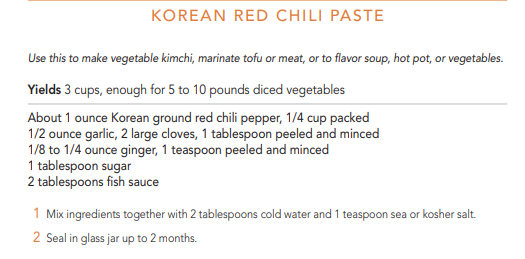
This week was all about the difference in various Asian cuisines, specifically from Japan and Korea. Lab was more relaxed for me this week. The dish I worked on was a simple Korean Red Chili Paste. It wasn’t as thick as I expected but I’m thinking it needed rice or some other form of gluten added to it. “Gochujang — one of the Korean "mother sauces" of jangs, or fermented sauces, that form the basis of Korean cooking, including doenjang and ganjang — is traditionally made by mixing malt, glutinous rice flour, Korean red pepper flakes and ground-up meju, a brick of dried fermented soybeans, said chef Hooni Kim, who owns Danji and Hanjan in New York City.” (Park, 2021)


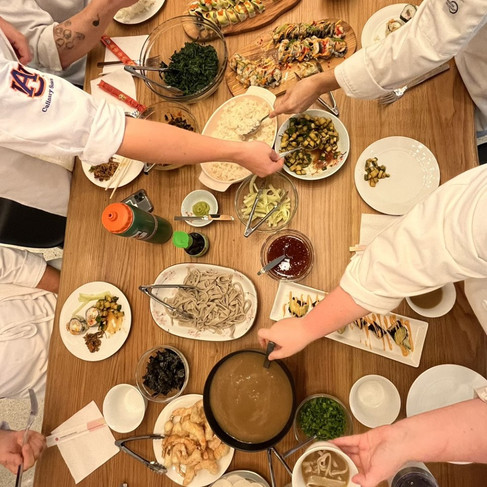
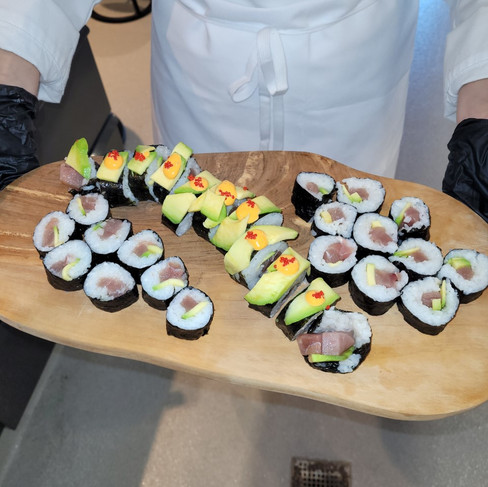
The groups that worked on the sushi and the Soba seemed to have a ton of fun. The sushi rolls turned out beautifully!



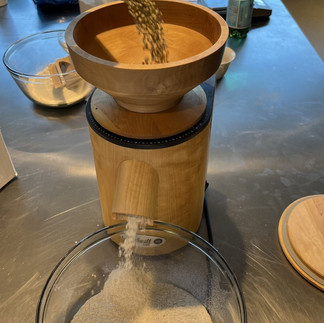
And the group that did the Soba…well…that was too cool. They ground their own buckwheat groats to make buckwheat flour for the Soba noodles. How neat is that?!





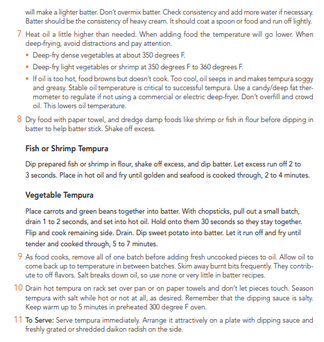
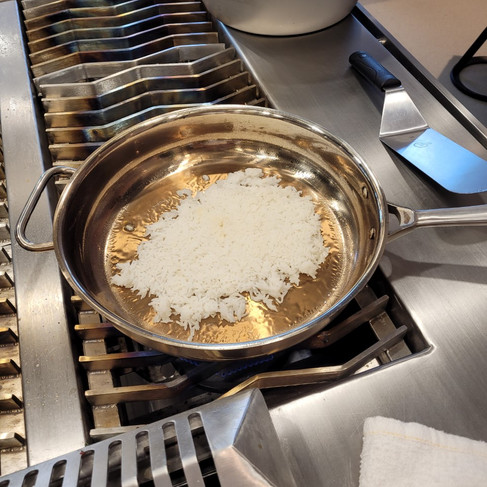
They needed an extra set of hands, so I jumped in and fried the tempura shrimp using the batter they created. They were nice and light in color with a definite crisp. They did an excellent job making the tempura batter.


Evaluation:
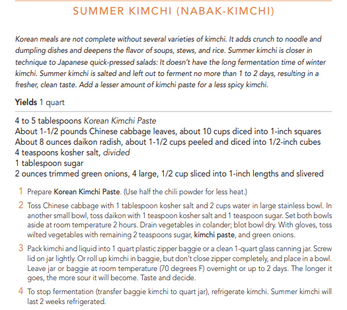
My group was tasked with the Korean Red Chili Paste, Summer Kimchi, and Bibimbap. Magen worked on dicing all the vegetables for the Kimchi and Will made the Bibimbap.




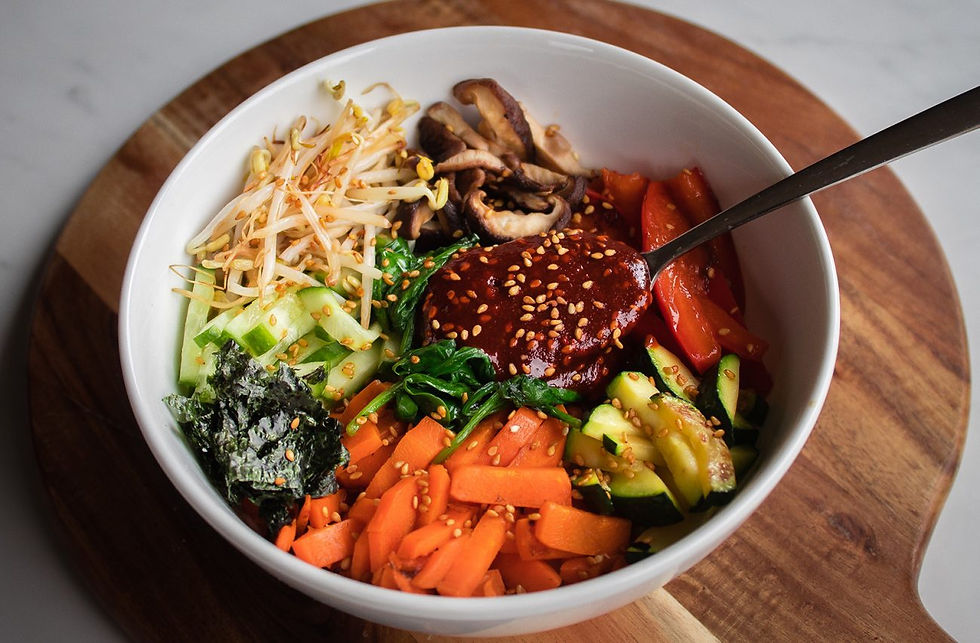
The Bibimbap consisted of multiple small dishes cooked separately then put together to make one complete dish. “Bibimbap is a popular Korean recipe that literally translates to “mixed rice”. It combines rice, meat, vegetables, and eggs into one bowl, and bibimbap sauce, commonly known as gochujang sauce, is mixed into the food to pair the ingredients together for an explosion of flavor. Bibimbap is highly customizable; you can choose your favorite vegetables and protein, and even sprinkle some organic seaweed snacks at the end to add some extra salt and crunch to your meal. The possibilities for this dish are endless.” (The Sauce, 2018)




I doubled the Korean Red Chili Paste recipe, since it was to be used in both the kimchi and the bibimbap. “Korean food without gochujang (Korean hot pepper paste) is like soup without salt - disastrous!” (The Sauce, 2018)


Conclusions:
I don’t really have much to say in the way of conclusions this week. I had very little to create in lab, so I used my spare time to make something out of the mind of Kat. 😊 We had some English Cucumbers leftover that really needed to be used in some way. I built an Asian inspired cucumber salad using some of the red chili paste I made. I added tamari for a savory umami flavor, some fish sauce for depth, minced garlic, sesame oil, and a pinch of minced ginger. It turned out quite well if I do say so myself. 😉 I garnished with brown and black sesame seeds for aesthetic appeal. It was a little heavy on the saltiness when I first tasted it. By transferring it to a separate bowl and leaving as much of the liquid behind as possible, it drastically cut down on the overpowering flavor of the tamari and gave the dish better balance.

References
“7 Popular Korean Dishes Using Gochujang.” The Sauce. https://www.kpopfoods.com/blogs/thesauce/7-popular-korean-dishes-using-gochujang. 01 August 2018.
“The gochujang gateway: How the Korean chili paste became so popular in the U.S.” Hanna Park. https://www.nbcnews.com/news/asian-america/gochujang-gateway-how-korean-chili-paste-became-so-popular-u-n1255748. 27 January 2021.


Comments