Week 11: Lebanon
- kelafoy
- Oct 26, 2022
- 6 min read
Updated: Oct 30, 2022
Introduction
Lebanon…what can I say? It’s a bit Mediterranean, a little European, and a lot Middle Eastern. This is one big powerhouse of techniques and flavor combinations! 😊 Read on to find out what’s in store for us.
Method of Cookery:
“When preparing kibbeh in ancient times, people used to smash with a pestle the Lamb meat inside a bowl or a mortar. Although this technique is considered scary by the ones that are strangers to the Lebanese cuisine, the resulting dish is a delicacy. Fortunately, since the cooking equipment has been developed, this method is not used anymore. The other methods that are popular in Lebanon are not typical only to this country, whatsoever. They are used in many other countries from Europe and Middle East. Each dish, nevertheless, requires being prepared in a certain way. Furthermore, each ingredient that is added to a dish may undergo one of the following cooking methods: frying, boiling, stewing, roasting, salting, drying and smoking. People from Lebanon use high quantities of herbs and spices, in order to enhance the flavor of the dishes. Therefore, seasoning is another cooking method that is widely used in the Lebanese cuisine.
The cooking equipment that is used in Lebanon was developed, in time. At first, people used a mortar named jorn and moddaqa – a tool that is similar to a pestle, to prepare the traditional dish of Lebanon, which is kibbeh. Later, when grinders and food processors began to be used in the Lebanese kitchen, these utensils became useless. However, they are still used in the rural areas of the country, by the poor people.
Besides these, the cooking tools that can be found in a typical Lebanese cuisine are similar to those that are used in Europe and in Northern America. The equipment that is utilized for preparing, storing and serving foods includes, but does not resume to: kitchen knives, forks, teaspoons, tablespoons, food scoops, turners, graters, grinders for spices, as well as boxes for storing them, plates, pans, trays, pots, bowls and devices for measuring the temperature and the weight. Food scales are used for adding ingredients to a recipe in certain quantities, while kitchen thermometers help when preparing the dishes at a certain temperature is desired. This way, overcooking is avoided.
Most Lebanese dishes don’t require you to purchase any special tools. However, having a coffee grinder helps with roasting and grinding spices and maximizes their volatile oils, which, in turn, provides your food with more flavour. (Wiki Recipes, 2011)
Prior Knowledge of the Dish:
When I tell you I know nothing about Lebanese cuisine…I mean exactly that. I. Know. NOTHING. I love to eat all foods from around the world, so I’m ecstatic to learn about this region. I love both European and Middle Eastern cooking, and I was surprised to find that Lebanon uses a combination of these two cooking concepts. Let’s keep moving and see what we can learn. 😊
Learning Objectives:
1. Introduce the long history of Lebanon, its geography, religious and cultural influences, and climate.
2. Discuss Lebanon’s important location at the edge of the Fertile Crescent, bordering the Eastern Mediterranean.
3. Introduce Lebanon’s culinary culture, its influence on other Middle East and Eastern Mediterranean countries, its two main culinary regions and dining etiquette.
4. Identify Lebanese and Middle Eastern foods, flavor foundations, seasoning devices, and favored cooking techniques.
5. Teach the techniques and succulent dishes of the Lebanon and the Middle East.
Background Information
Origin & History:
“Situated between the east and the west, Lebanon is a culinary and cultural crossroad where western civilization is believed to have begun. The cuisine of this ancient land is diverse and engraved in history with both the eastern and western influences evident in its cuisine.
A unique cultural history has paved the way for Lebanese food to be categorized as one most popular of Middle Eastern cuisines. For the majority of history, Lebanon has been ruled by foreign powers that have influenced the Lebanese cuisine. From the 16th Century, the Ottoman Empire controlled Lebanon and introduced a variety of foods that have become staples in the Lebanese diet, including baklava, pickled vegetables and lamb dishes.
After the Ottomans, France took control of Lebanon, when the country won its independence. During this time, the French introduced an array of their most widely eaten foods, particularly treats such as cheese and a variety of pastries. The genius of Lebanese cookery is the simplicity and freshness that rely on the product of the sun, the sea and the land. It has the sophistication and finesse of the European cuisine with the exotic aromas of Middle Eastern spices.” (Zahli, 2022)
Methods Used:
“Vertical roasting
Since the early days of the Ottoman occupation Lebanese cooks have been roasting meat on vertical spits; this enables the meat to cook in its own fats and juices making it tender and delicious. Our most famous dish utilising the vertical roasting technique is none other than shawarma.
Grilling
Few cultures have been grilling longer than we have, with our traditional ground lamb kufta kebabs one of our most famous grilled specialties. Lebanese cuisine also includes a variety of grilled skewers that can include all manner of meats and vegetables.
Baking
Wood fired ovens have been in use in the Middle East for eons, so it should come as no surprise that Lebanese people have mastered the art of baking. Our many baked specialties include the flat bread ‘Lebanese pizzas’ known as manoosh, as well as our impossibly delicious baklava.
Frying
While Lebanese don’t tend to cook in oil very much frying certainly has its place in a true Lebanese kitchen, particularly when it comes to preparing the perfect falafel balls or a delicious batch of fried kebbeh.” (Man^Oosh, 2022)
Dish Variations:
“Today, the cuisine of Lebanon is the epitome of the Mediterranean diet. It includes an abundance of starches, fruits, vegetables, fresh fish and seafood. It also includes copious amounts of garlic and olive oil. While the cuisine of Lebanon doesn’t boast an entire repertoire of sauces, it focuses on herbs, spices and the freshness of ingredients; the assortment of dishes. The meals are full of exotic, earthy flavours and their desserts jam-packed with succulent rose water and orange blossom. The food of Lebanese culture is a celebration of life; it’s fresh, colourful and incredibly diverse. (Zahli, 2022)
References
“Awesome Traditional Lebanese Ingredients & Cooking Techniques.” Man^Oosh. https://www.manoosh.com.au/awesome-traditional-lebanese-ingredients-cooking-techniques/#:~:text=Vertical%20roasting,is%20none%20other%20than%20shawarma. 2022.
“Lebanese Cuisine.” Wiki Recipes. https://recipes.fandom.com/wiki/Lebanese_Cuisine. 2011.
“The History of Lebanese Cuisine.” Zahli Restaurant. https://www.zahlirestaurant.com/the-history-of-lebanese-cuisine/#:~:text=For%20the%20majority%20of%20history,pickled%20vegetables%20and%20lamb%20dishes. 2022.
Dish Production Components
Recipes:








Plan of Work:

Sources:




Reflection & Summary of Results
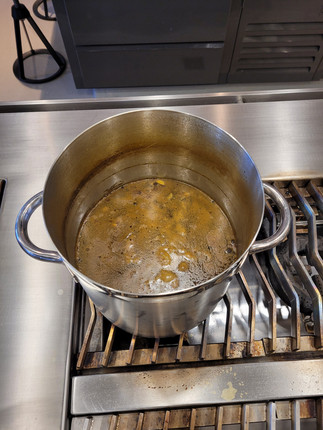
What Happened(?): As expected…CRAZY DAY! Well…not too crazy. It was definitely interesting when our lab (kitchen) was filled with The Golden Eagles (Auburn Alumni). Aubie even came by to see us. 😊


I didn’t get a photo of all the dishes this week like I normally do. I got a couple of the others’ tasty creations though.


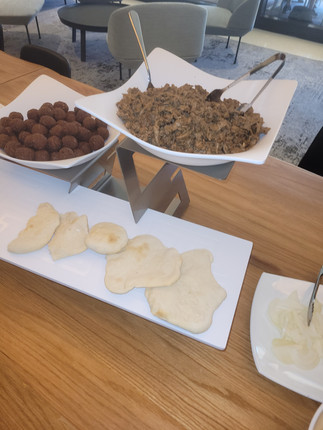


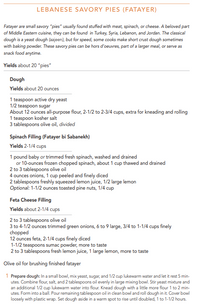
My partner, Natasha, and I were tasked with the Fatayer (Lebanese Savory Pies). “Fatayer are small savory “pies” usually found stuffed with meat, spinach, or cheese. A beloved part of Middle Eastern cuisine, they can be found in Turkey, Syria, Lebanon, and Jordan. The classical dough is a yeast dough (aajeen), but for speed, some cooks make short crust dough sometimes with baking powder. These savory pies can be hors d’oeuvres, part of a larger meal, or serve as snack food anytime.” (Allen, 2014) We stuffed our pies with halloumi cheese. It’s a saltier cheese that crumbles like feta cheese. It has a firmer texture than feta though, and it releases a lot of moisture.

Evaluation: Chef Plana was kind enough to prepare the dough ahead of time since we were beginning earlier and expecting visitors to come. She knew we would all be in somewhat of a time crunch and tried to give each of us an advantage if possible. We struggled quite a bit with the dough. It didn’t want to hold shape whether we chose a square or a boat. It kept collapsing after being left to rest for a few minutes while we continued stuffing and shaping additional pies. We tried a few in an empanada type shape to see if it would stay sealed. It held shape beautifully until it baked. The side didn’t open, but you could visibly see the separation at the seam. After baking they came out a bit underdone where the halloumi filling was, but hard and overbaked on the surface.


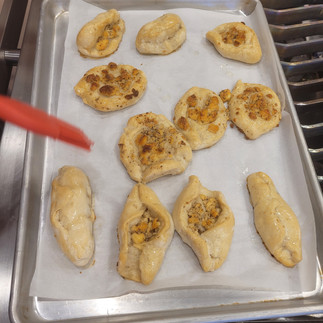
We had some cheese filling left after using the first batch of dough, so Chef suggested we make an additional batch. We had time, so why not? 😊

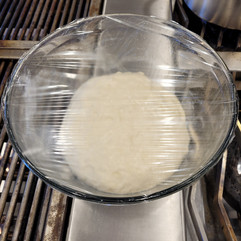



Conclusions: The second batch turned out PERFECT! I think refrigerating the dough ahead of time with the first batch made the gluten harder to work with. It kept pulling back and didn’t bake as well. The second batch had an almost marshmallow-like quality to it once it was baked. It was soft and pillowy, and had beautiful tiny air pockets. The salty halloumi mixed with the smokiness of the sumac powder made for a tasty explosion of flavor. You can see the difference in the photos below between the two batches.



Next week we’re off to the Middle east! I wonder what surprises await us there?
References
“Discovering Global Cuisines.” Nancy Krcek Allen. file:///C:/Users/katla/Downloads/vdoc.pub_discovering-global-cuisines-traditional-flavors-and-techniques.pdf. 2014.



Comments