Week 9: Boiling, Poaching, and Seafood (II)
- kelafoy
- Oct 12, 2021
- 7 min read
Updated: Oct 17, 2021
Introduction
“This week we are poaching seafood which is a moist cooking method using convection heat and is a quick method of cooking foods. We are also boiling some vegetables. When we discuss boiling, we mean simmer (for the most part), and another variation of boiling is poaching.” (Canvas, 2021)
Method of Cookery:
“There is a clear distinction between boiling, simmering, and poaching:
The definition of Poaching is cooking foods in the required amount of liquid at just below boiling point. For poaching, there are two methods - Submersion (Deep) poaching and Shallow poaching. Submersion poaching is when the food is completely submerged in the cooking liquid. An example is poaching an egg. Shallow poaching on the other hand, involves partially submerging the food in a minimum amount of cooking liquid in a covered pan in the oven.
The flavor of the cooking liquid has a considerable impact on the final flavor of the product, one can use water, stock, court bouillon, or milk. A court bouillon is a stock that has been enhanced with wine and is typically used with seafood. The poaching liquid is commonly preferred to as cuisson.” (Canvas, 2021)
Cuisson is also the French term for cooking. “Cuisson: French for “cooking” but used by chefs to sound wiser when they talk about something being perfectly cooked.” (Preston, 2021)
Prior Knowledge of the Dish: I have no prior knowledge of any of our dish components this week. (Well…I’ve made tomato sauce before. I always make my spaghetti sauce from scratch by boiling down my tomatoes and simmering with the seasonings for about 4 – 6 hours.) For me, that means it’s going to be an exciting lab. I love to try new recipes, and it’s even better when it’s something completely out of my wheelhouse.
I think I’m most excited about creating the fettucine carbonara. Carbonara is a favorite dish of mine, but I’ve never attempted to create it myself. I haven’t had it in years, because of my food allergy. Some people put onions in their carbonara, even though that isn’t the traditional way. You can’t be too careful when dealing with an allergy to any food or food product.
I’ve never tried poached seafood before. Honestly, it looks a little gross. It may be that I haven’t seen it prepared properly, but it looks kind of slimy. Since we eat with our eyes first, our nose second, and our mouth last…the lack of visual appeal has always been a turnoff for me.
Learning Objectives:
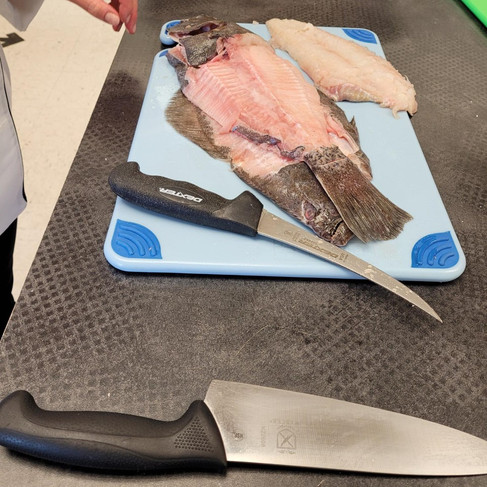
· Identify the structure and composition of fish.
· Prepare seafood for cooking - poaching and boiling
· Prepare a bechamel sauce and derivative sauce
· Prepare a velouté sauce and derivative sauce
Background Information
Origin & History:
Fish Duglere: “This classic French fish recipe was a creation of Adolphe Dugléré which was renowned French head chef working at the Cafe Anglais in 1866 which became the most famous Paris restaurant of the 19th century. At the core of that dish is freshly filleted fish cooked in a fish stock made with the fish bones produced during filleting. the fish is then serve with a classic sauce vin blanc ( French white wine sauce )in which diced tomatoes and parsley have been added this amazingly flavorsome French sauce is a classic example of what can be achieved with a fresh whole fish, butter, cream, white wine and a few other ingredients. The dugléré sauce is just hugely addictive and is guaranteed to please anyone. And this is mainly due to the fact that your palate is able to understand very easily the combination of flavors that exist in the sauce.” (Stephane, 2018)
Cauliflower Mornay: “Mornay sauce is a Béchamel, or cream sauce, enriched with an egg yolk as well as with Gruyère-style cheese. It appears that the sauce was created in the 19th century at the ultra-chic (at the time) restaurant Le Grand Véfour, which sits beneath the arcades of the Palais Royal gardens in the heart of Paris. It may have been named for a nobleman who frequented the establishment, the Marquis de Mornay, or for his brother, the count of Mornay. There seems to be no agreement on this point, however. (Meg, 2020) I learned in one of our instructional videos that Mornay sauce is just a Béchamel sauce with cheese added to it.
Fettuccine Carbonara: “Carbonara is most associated with Rome and the Lazio region, but as with so many Italian dishes, in Italy, its origin provokes much speculation and debate. Some connect it to pasta cacio e uova, a Neapolitan dish of pasta tossed with melted lard, beaten raw eggs, and cheese, as documented in Ippolito Cavalcanti's 1839 Neapolitan cookbook. Because the name comes from the word carbonaro, “coal burner,” some believe the dish was created as a hearty easy-to-make meal by men working outdoors for long periods. Others trace it to the Allied liberation of Rome in 1944, with American GIs bringing their daily ration of eggs and bacon to local restaurants to add to the limited Italian menu. Supporting this story is the first written reference to the dish in newspaper La Stampa in 1950, describing it as a dish prized by American servicemen. Shortly after, carbonara also appears in Elizabeth David’s classic 1954 book Italian Food.” (Segan, 2021) We were taught by Chef Leo to serve our carbonara immediately, because it doesn't sit well for long before consumption. He also instructed us to never add heavy cream to a carbonara. The creaminess of the dish comes from the eggs. If more liquid is needed, we are to use our pasta water.
Methods Used:
“Boiling is when a food is fully submerged in a liquid that is boiling - large bubbles and rapid movement (rolling boil) at a temperature of 212̊ F.
Simmering is when a food is fully submerged in a liquid that is just off the boil - small bubbles that break the surface at a temperature of 185 – 205̊ F.
Poaching is when a food is partially or fully submerged in a liquid that is at 160 -180̊ F.” (Canvas, 2021)
Dish Variations:
“Returning to sauce Mornay, it was apparently served at first over barbue, or brill, a flatfish similar to a turbot, but its range has expanded in modern times. You can find it in recipes for eggs benedict, pasta, salmon, sea scallops and veggies from broccoli and brussels sprouts to leeks and asparagus. And, of course, cauliflower. Often, a dish bathed in Mornay sauce is popped into the oven to brown, in the process becoming a gratin. As for the cheese to use, in France it is always Gruyère, Comté or a similar cheese, while in Britain the go-to cheese is cheddar.” (Meg, 2020)
“There may be no more beloved Italian dish than carbonara: hot pasta tossed with a creamy sauce of raw beaten eggs, accentuated with crisp bits of guanciale, and finished with a shower of grated aged Pecorino Romano cheese plus freshly ground black pepper. While it is also made with fettuccine, linguine, or bucatini, spaghetti remains the canonical carbonara pasta shape, and the classic recipe contains no butter, cream, or garlic.” (Segan, 2021)
References
“Carbonara: Origins and Anecdotes of the Beloved Italian Pasta Dish.” Francine Segan. https://www.lacucinaitaliana.com/italian-food/italian-dishes/carbonara-origins-and-anecdotes-of-the-beloved-italian-pasta-dish?refresh_ce=. 06 April 2021.
“Chou-fleur sauce Mornay.” The Everyday French Chef, Meg. https://everydayfrenchchef.com/chou-fleur-sauce-mornay/. 03 January 2020.
“Fancy French cooking terms made easy.” Matt Preston. https://www.taste.com.au/entertaining/articles/fancy-french-cooking-terms-made-easy/ibbk7rrt. 2021.
“Fish Filet With Dugléré Sauce.” The French Cooking Academy. Stephane. https://www.thefrenchcookingacademy.com/fish-filet-with-duglere-sauce/. 19 October 2018.
“Week 9: Week 9 Overview.” Canvas. https://auburn.instructure.com/courses/1381074/pages/week-9-week-9-overview?module_item_id=20251761. 2021.
Dish Production Components
Recipes:


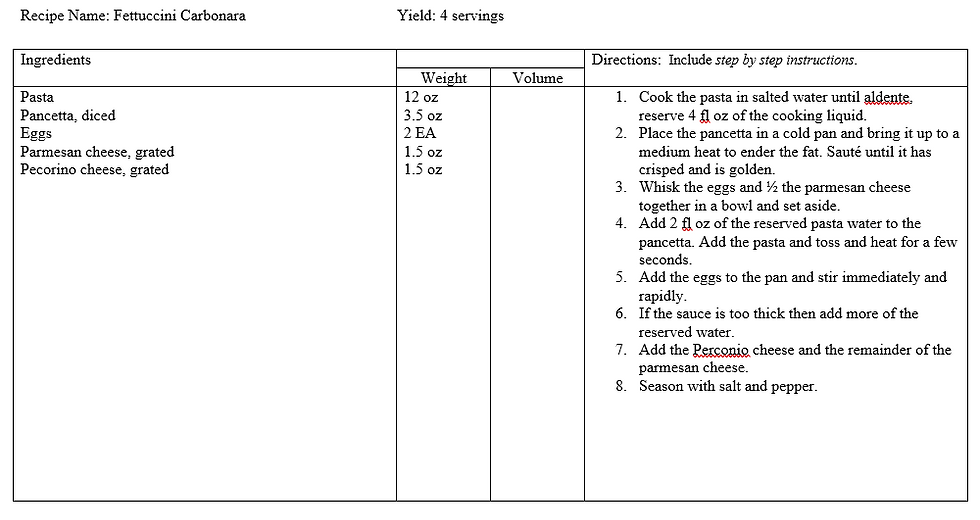
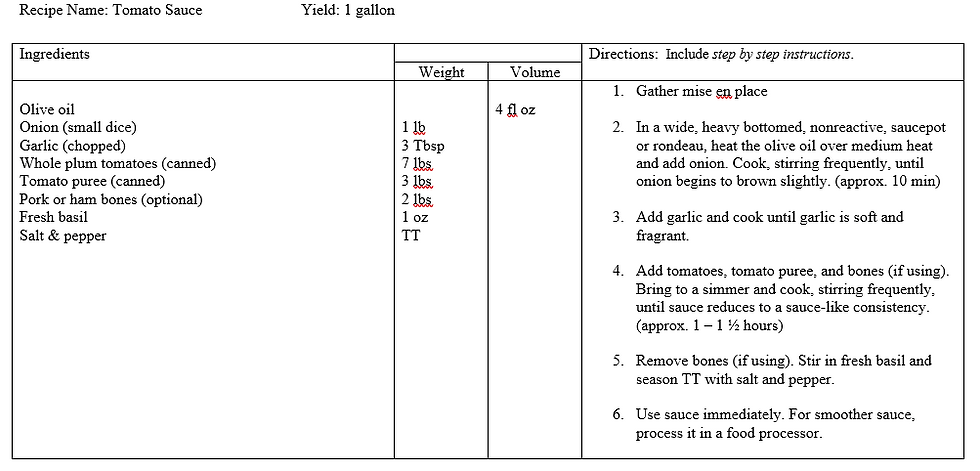
Plan of Work:
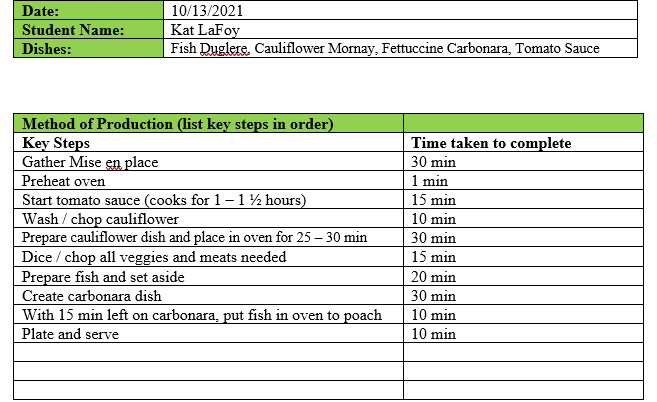
Plate Presentation:

Sources:


Reflection & Summary of Results
What Happened(?): Poached fish…hhmmmmm…I’m still unsure about this one. It’s a texture thing for me. I didn’t try it due to the recipe having shallots, but my lab partner did. He wasn’t really a fan. The consensus is that it’s basically boiled fish, which doesn’t sound very appetizing. We topped it with tomato sauce to add some depth to it, but it still wasn’t a hit. The cauliflower mornay turned out really well. I loved the mornay sauce, but cauliflower is one of my least favorite things to eat. I will happily create a mornay in the future for homemade mac and cheese. Now…as for the fettucine carbonara…YES PLEASE!!! It was so good I took leftovers home to my fiancé and had it again for dinner.





Food Cost:

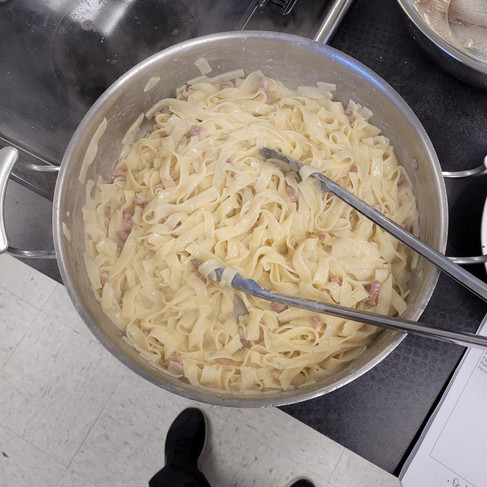
Evaluation: I was really nervous about scrambling my eggs in the carbonara. I managed to get the consistency just right, and it turned out beautifully. I feel like we had too many noodles though. The pasta overpowered the pancetta, and you could barely tell there was any meat in the dish at all.


The poached fish left something to be desired in the flavor department. I get nervous when using salt because I tend to have a heavy hand with it. A pinch more may have opened up the flavors a little better.

The cauliflower mornay could have used a few more minutes in the oven. We were cutting it close with our timing and pulled it out a little sooner than I would have liked. It also tasted a little bland.


Conclusions:
“Moist cooking methods do not brown foods, so in order to add extra flavor, there is every reason to use a flavorful broth, stock, juice or even milk as your poaching liquid. Many people wonder, ‘why poach if the food is just going to look pale and unattractive since it doesn’t brown?’ In the case of lean proteins, such as fish and chicken, the food is served with a sauce which serves to “camouflage” the pale meat.” (Jones, 2018) In the future using a fish stock instead of water should enhance the flavor profile of the fish as well.
“Both Jane Grigson, in her Vegetable Book, and Gary Rhodes in New British Classics advocate gently frying the drained cauliflower in butter before adding it to the dish, without colouring the florets. This, I assume, is to enrich the flavour, but I can't taste any difference in the finished dish. It does give me an idea though: I've found browning cauliflower, whether for soup, curry or just as a side dish, makes it infinitely tastier by bringing out the sweetness, so I'm going to sauté my florets over a rather higher heat before adding them to the sauce.” (Cloake, 2012)
I think our plate presentation turned out beautifully for both dishes. What do you think? Would you try them?



References
“How Not to Cook with Water – Poaching.” G. Stephen Jones. https://www.reluctantgourmet.com/how-not-to-poach/. 27 April 2018.
“How to cook perfect cauliflower cheese.” Felicity Cloake. https://www.theguardian.com/lifeandstyle/wordofmouth/2012/nov/15/how-cook-perfect-cauliflower-cheese. 14 November 2012.


Comments