Week 7: Pastry Basics
- kelafoy
- Feb 23, 2022
- 4 min read
Introduction
It’s all about the basics this week, pastry basics that is. 😉 “The term pastry comes from the word paste, meaning, in this case, a mixture of flour, liquid, and fat. In the bakeshop, pastry refers both to various pastes and doughs and to the many products made from them.” (Gisslen, 2022)
Method of Cookery:
“Emulsification technique
Emulsions play a key role in pastry since they are the structures responsible for creaminess on, for example, ganaches, custards or ice creams. When understanding what an emulsion is, how is it formed or undone and what factors influence its stability, you comprehend why emulsions bring us a creamy mouthfeel, something already upholded in the article “Beyond the lines of traditional pastry – redefining the concept of creaminess”.
It is really important to note that creaminess is not directly associated with traditional ingredients, as it is obtained thanks to this texture creating technique: emulsification.
Aeration technique
Aerated textures, also called foams, are very representative in the world of pastry and bakery: from plated desserts foams, through several kind of meringues, guimauves, mousses and ice cream, to sponge cakes and even bread. There are many aerated textures with different appearance and mouthfeel, but they all have something in common: they are extremely delicate, so it is essential to learn how to create and stabilize them.
Thickening technique
Thickening is the process of increasing viscosity in recipes. But why is it so essential to control this parameter? Viscosity greatly influences the mouthfeel caused by food and this is as important as the flavour of the product itself. For this reason, when you master the thickening technique, you can improve and refine your textures to create a unique tasting experience.
Gelation technique
If you think of gelling, the first textures that come to mind are surely those that have a truly gelatinous texture, such as jams, marmalades, compotes or pâte de fruit. However, most pastry and bakery recipes are gelled to maintain their shape and stability, for example mousses, foams or even bread.
As you can see, it is a fundamental technique for the creation and execution of stable recipes and, to work with it, each ingredient and its parameters must be considered.” (Bordas, 2020)
Prior Knowledge of the Dish:
I LOVE puff pastry! I can’t say that I have ever made it from scratch though. We used store bought puff pastry to make apple-brie bites in our Food Production class during the Spring 2021 semester. I have also used it a lot at home to make things my family enjoys like gruyere, spinach, and mushroom mini tarts, cheeseburger bombs (bite-size of course), cinnamon twists, you name it. Puff pastry is extremely versatile. You can make almost anything to please almost anyone with it.
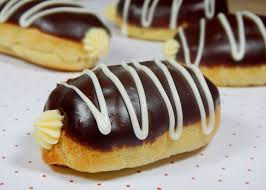
I am totally stoked about making the Pâte à Choux. 😊 Chocolate éclairs are probably one of my top 5 favorite sweets to eat on this entire planet. If I can learn to master them myself, I will never have to purchase them from a grocery store again. Now that’s what I call #goals.
I’ve created various meringues before, so I am really looking forward to trying something with more difficulty this week. My lab partner, AP, found a recipe for a Pavlova we want to try. It looks amazing! I hope we can recreate it.

Learning Objectives:
· Prepare Pâte Brisée and Short Pastries.
· Prepare puff pastry dough, blitz puff pastry dough, and reversed puff pastry dough, and make simple pastries from these doughs.
· Prepare Pâte à Choux (éclair paste) and make simple pastries from it.
· Prepare strudel dough, handle commercial phyllo (strudel) dough, and make pastries using either homemade or commercial dough.
· Bake meringue and meringue-type sponges and assemble simple desserts with these meringues.
Background Information
Origin & History:
“Originally made by the Egyptians, one of the earliest forms of pastry was made by combining flour and water into a paste which was then wrapped around meat to be baked. Pastries were later developed in the Middle East and would eventually be brought to Europe, gaining popularity in the medieval period. By the 1600s, different types of pastry were developed, such as flaky pastry which is made from many thin layers or puff pastry which is a very light mixture with a lot of air in it. Pastry is often used as a casing for sweet fillings. Filo and choux are examples of different types of pastry used to make sweet pastries, while other varieties such as croissants or Danish pastries are made with yeast.” (Macmillan Dictionary, 2019)
Methods Used:
“Different kinds of pastries are made by utilizing the natural characteristics of wheat flour and certain fats. When wheat flour is mixed with water and kneaded into plain dough, it develops strands of gluten, which are what make bread tough and elastic. In a typical pastry, however, this toughness is unwanted, so fat or oil is added to slow down the development of gluten. Pastry flour can also be used since it typically has a lower level of protein than all-purpose or bread flours.
Lard or suet work well because they have a course, crystalline structure that is very effective. Using unclarified butter does not work well because of its water content; clarified butter, or ghee, which is virtually water-free, is better, but short crust pastry using only butter may develop an inferior texture. If the fat is melted with hot water or if liquid oil is used, the thin oily layer between the grains offers less of an obstacle to gluten formation and the resulting pastry is tougher.” (Wikipedia, 2022)
Dish Variations:
“Pastry is a dough of flour, water and shortening (solid fats, including butter or lard) that may be savoury or sweetened. Sweetened pastries are often described as bakers' confectionery. The word "pastries" suggests many kinds of baked products made from ingredients such as flour, sugar, milk, butter, shortening, baking powder, and eggs. Small tarts and other sweet baked products are called pastries. Common pastry dishes include pies, tarts, quiches, croissants, and pasties.” (Wikipedia, 2022)
References
“Pastry.” Wikipedia. https://en.wikipedia.org/wiki/Pastry. 2022.
“Pastry Basics.” Wayne Gisslen. Professional Baking 8th Edition. Page 325. 2022.
“The 4 pastry techniques to achieve perfect textures.” Jordi Bordas. https://www.jordibordas.com/en/blog/the-4-pastry-techniques-to-achieve-perfect-textures/. 23 October 2020.
“Word of the Day: pastry.” Macmillan Dictionary. https://www.macmillandictionaryblog.com/pastry#:~:text=Originally%20made%20by%20the%20Egyptians,popularity%20in%20the%20medieval%20period. 2019.
Dish Production Components
Recipes:


Plan of Work:

Plate Presentation:

Sources:



Comments