Week 12: Cookies & Frozen Desserts
- kelafoy
- Mar 31, 2022
- 5 min read
Updated: Apr 1, 2022
Introduction
Cookies and frozen desserts are on the agenda for week 12. I am somewhat worrisome about the icebox cookie recipe this week. I feel confident in the dough but not the pattern. We are going to attempt a checkerboard cookie, and I can’t wrap my head around the instructions to create it. Oh well…I guess we’ll see what happens after lab is complete. 😉
Method of Cookery: Baking & Churning
“Baking is a method of preparing food that uses dry heat, typically in an oven, but can also be done in hot ashes, or on hot stones. The most common baked item is bread, but many other types of foods can be baked. Heat is gradually transferred "from the surface of cakes, cookies, and breads to their center. As heat travels through, it transforms batters and doughs into baked goods and more with a firm dry crust and a softer center".” (Wikipedia, 2022)
“Ice cream makers may prepare the mixture by employing the hand-cranking method or by employing an electric motor. The resulting preparation is often chilled through either pre-cooling the machine or by employing a machine that freezes the mixture.” (Wikipedia, 2022)
Prior Knowledge of the Dish: I get A TON of requests for cookies around the holidays. I make these cute little DIY cookie kits for school Christmas parties…


…and I make certain special request items like holiday fudge bars, teacher gifts, or themed cookies.




I have a decent handle on the process of making cookies, but I am really interested to see how the ice cream making goes this week. I have never made ice cream from scratch, starting with a Crème Anglaise. To be honest…I am quite nervous.
Learning Objectives:
Cookies
Describe the causes of crispness, softness, chewiness, and spread in cookies.
Prepare cookie doughs by the three basic mixing methods.
Prepare eight basic types of cookies: dropped, bagged, rolled, molded, icebox, bar, sheet, and stencil.
Bake and cool cookies properly.
Explain how to judge the quality of cookies and correct defects in them.
Frozen Desserts
Judge the quality of ice creams and sorbets and common ice cream and sorbet desserts.
Prepare ice creams and sorbets.
Prepare still-frozen desserts, including bombes, frozen mousses, and frozen soufflés.
Background Information
Origin & History: “According to culinary historians, the first historic record of cookies was their use as test cakes. A small amount of cake batter was baked to test the oven temperature. The earliest cookie-style cakes are thought to date back to 7th century Persia A.D. (now Iran), one of the first countries to cultivate sugar (luxurious cakes and pastries in large and small versions were well known in the Persian empire).” (What’s Cooking America, 2022)
“History of the ice cream spans the period of last two and a half thousand years, during which they managed to push the boundaries of technological knowledge, fashion, and culinary finesse. Ice cream timeline covers the entire span of the modern human civilization. They first appeared in ancient Persian Empire, traveled to Rome, China, received massive advancement in 10th century Middle East, returned to Renaissance Europe and from them conquered entire world.” (Ice Cream History, 2022)
Methods Used: We are using the creaming method for all our cookie projects this week. “The creaming method for cookies is the most common mixing method for making chocolate chip cookies, and many other varieties of cookies. This method gets its name due to the process of creaming butter and sugar together during the first step of the mixing process.” (Baker Bettie, 2018.)
When making the ice cream this week, we will start with a Crème Anglaise cooked on the stovetop. It will then be churn-frozen, meaning the mixture will be constantly mixed while it is being frozen. According to our textbook, “The churning keeps the ice crystals small and incorporates air into the dessert.” If we don’t churn the ice cream, it will become frozen solid.
Dish Variations: There are 155 “notable cookies” according to Wikipedia.org. I am sure this is not a complete list, but it is comprehensive.
You can google frozen dessert dish variations and come up with “Our 101 Best Frozen Dessert Recipes” or “33 Simple Frozen Desserts”.
I’m sure the variations on these two learning objectives are vast. It may not even be possible to truly come up with all of the variations when dealing with such a versatile base in the case of both cookies and frozen desserts.
References
“Baking.” Wikipedia. https://en.wikipedia.org/wiki/Baking. 2022
“Frozen Dessert and Ice Cream History.” Ice Cream History. http://www.icecreamhistory.net/frozen-dessert-history/. 2022.
“History of Cookies.” What’s Cooking America. https://whatscookingamerica.net/history/cookiehistory.htm. 2022.
“Ice Cream Maker.” Wikipedia. https://en.wikipedia.org/wiki/Ice_cream_maker. 2022.
“The Creaming Method for Cookies.” Baker Bettie. https://bakerbettie.com/the-creaming-method-for-cookies/. 3 October 2018.
Dish Production Components
Recipes:


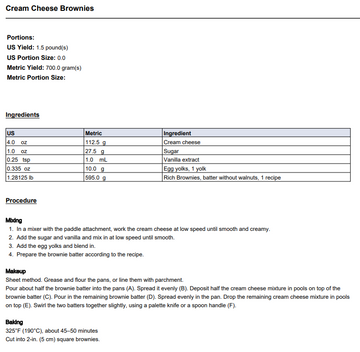


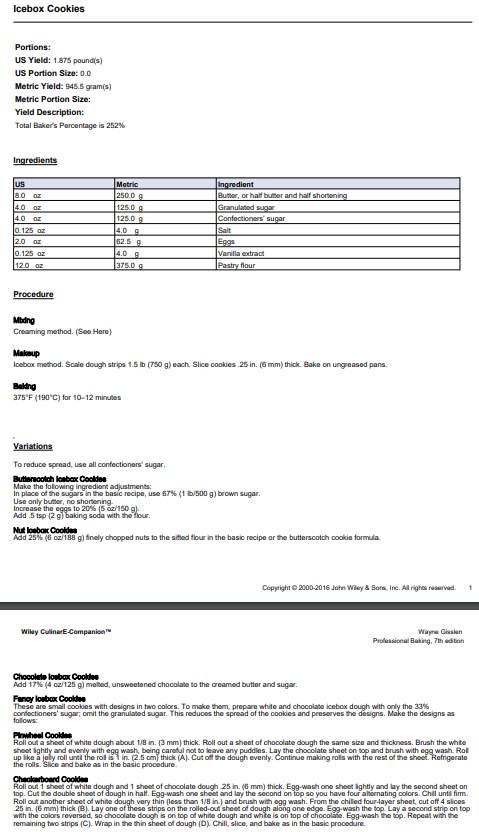


Plate Presentation:

Sources:





https://www.verybestbaking.com/toll-house/recipes/original-nestle-toll-house-chocolate-chip-cookies/
Reflection & Summary of Results
What Happened(?): Since we had so many recipes to choose from this week, and time was limited, Chef gave us the option of combining categories…rolled or mold (this includes the icebox method) …bagged or dropped…sheet or bar…and frozen dessert. This means each group needed to make 4 separate dishes this week.


The guys in our class keep us entertained from week to week, for sure! This was one of their creations this week...


Each group created ice cream using vanilla as the base recipe. We were missing two people this week and only have two ice cream churns, so we split into 2 groups to make the ice creams. I was tasked with creating the ice cream for our group. I made a vanilla bean Crème Anglaise and added guava puree to the mixture, allowing the flavor to slowly develop as it churned.


Evaluation: The color of the ice cream…or lack thereof…was not appealing at all after adding the guava. It looked very similar to chicken paste.

I don’t know about you, but if I saw that sitting there as a frozen dessert, I would pass by it faster than a NASCAR driver at the Daytona 500. I added a little red gel food coloring to create a more tempting hue.

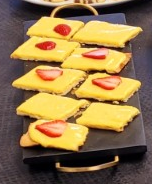
The sheet or bar method was completed by one of my teammates today. She created a lemon curd and spread it over parbaked short dough and topped it with fresh strawberries. It was delicious!


Conclusions: Our icebox cookies (rolled or mold method) did not work out as planned. The instructions for creating the checkerboard may have left something out because everyone struggled with it. Ours came out looking more tiger striped.


I guess that’s perfect since we’re Auburn students. 😉
One of our fellow classmates found a YouTube video using a different assembly method and her checkerboard cookies looked amazing!

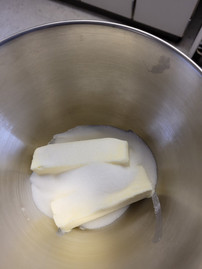
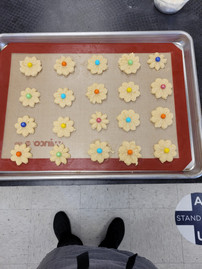
For our bagged or dropped method I really wanted to make a peanut butter/hazelnut cookie. My lab partner was out sick, so I joined another group and they outvoted me on the cookie choice. I wound up making a butter tea cookie. I chose a Spritz press to create the shapes of the cookies. It was a struggle at first, but for a plain cookie it tasted nice. It is definitely something that should be paired with coffee or tea of some kind.






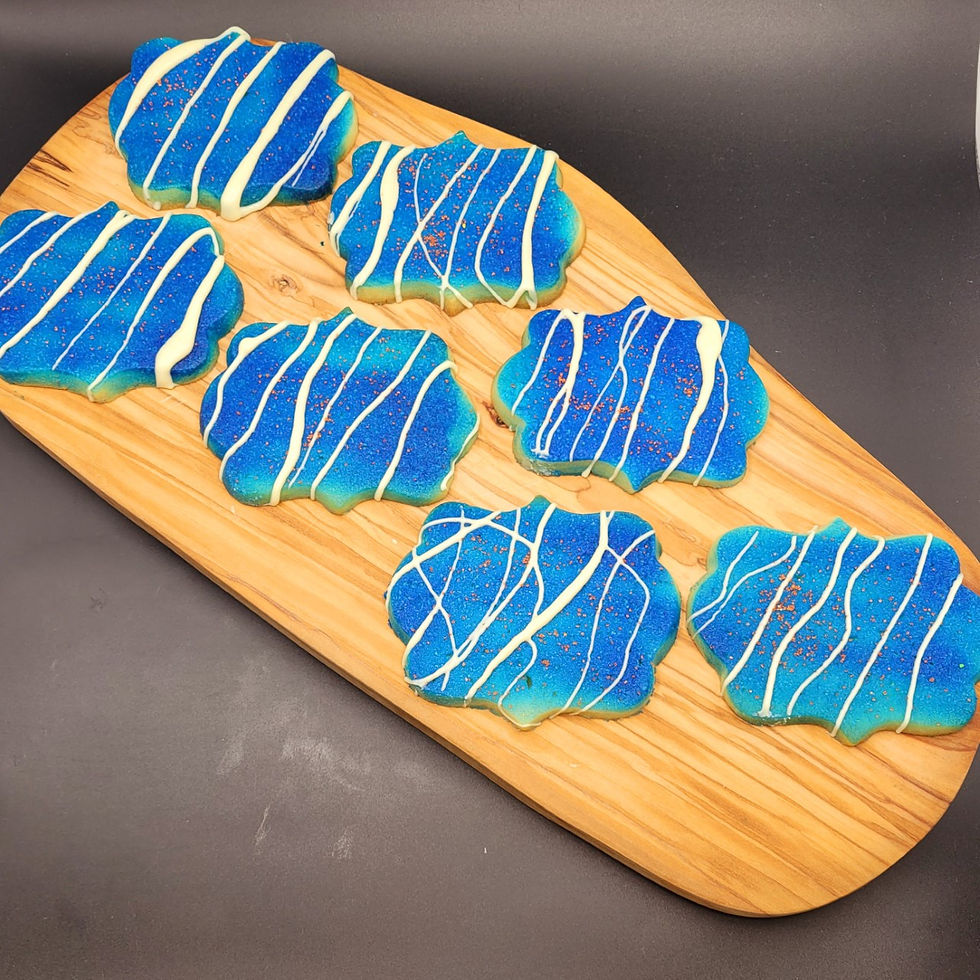
Since I wasn’t very pleased with my initial butter tea cookie idea, I wanted to dress it up a little. I rolled out some leftover dough and used a cookie cutter to make a scalloped shape. I made sure to chill the dough before baking to keep the cookies from spreading and losing their shape in the oven. Once cooled I dusted them with blue edible spray paint, orange sprinkles, and a drizzle of tempered white chocolate.
References


Comments