Week 7: Escalope de Porc a la Normande with Lyonnaise Potatoes & Green Beans
- kelafoy
- Sep 28, 2021
- 8 min read
Updated: Oct 4, 2021
Introduction
We are continuing dry cooking methods this week with a focus on Sauté.
Method of Cookery: Pork and Dry Cooking Methods: Sauté
Prior Knowledge of the Dish: I have cooked pork one thousand different ways in my lifetime. Okay not really 1,000 😊…but I have cooked A LOT of pork. Pork chops and mashed potatoes are a once per month occurrence during mealtime in my home. My Prussian grandmother taught me to pound out pork for tenderizing purposes when I was old enough to see over the countertop. She even taught me to use a grocery sack and a sideways hammer when there is no meat mallet to be found. That is one of my first memories of being in the kitchen with my Omi. As I got older, she showed me how to create her perfect potato pancakes to pair with pork medallions and asparagus in a white gravy. The flavor combination is AMAZING!!!!! I am really excited about trying a Normande Sauce this week. I have yet to experience creating one, and I’m interested to see how well I can do without breaking the sauce.
As for the Lyonnaise Potatoes, they are almost identical to what my Omi called “home fries”. She would thinly slice onions and place them in a skillet to begin browning until they were lighter in color, but not translucent. She would then remove the onions and cook her sliced potatoes in the same cast iron skillet with an entire stick of butter on high heat to crisp the potato edges. Once the potatoes were cooked halfway through, the onions were added back to the pan to allow all components of the dish to finish cooking together.
Learning Objectives:
· Identify the structure and composition of poultry.
· Prepare pork for cooking - sauté
· Prepare Lyonnaise Potato
· Make a vinaigrette
“This week we are sautéing food which is a dry cooking method and is a quick method of cooking foods. Sautéing is one of the four variations of shallow frying - other shallow frying methods include: Shallow Fry (Pan Fry), Griddle, and Stir Fry. Shallow frying involves cooking food in a small quantity of preheated fat or oil in a shallow pan or flat surface like a griddle. Frying involves browning of food. For sautéing, tender cuts of meat and vegetables are cooked in sauté or frying pan. The presentation side is always cooked first as it will have a better appearance as the fat will be clean at that stage of cooking. After the food is cooked on both sides the fat is discarded and the pan is de-glazed to make a sauce.” (Canvas, 2021)
Background Information
Origin & History:
“An escalope is traditionally a piece of boneless meat that has been thinned out using a mallet or rolling pin or beaten with the handle of a knife, or merely butterflied. The mallet breaks down the fibers in the meat, making it more tender. But the thinner meat cooks faster with more moisture loss. The meat is then coated and fried. Paillard is an older French culinary term referring to a quick cooking, thinly sliced or pounded piece of meat. In France, it has been largely replaced by the word escalope. The term escalope originated in France. It first appeared in cookery terminology late in the 17th century as a dialectal expression in the northeast of rural France originally meaning a shelled nut or mollusk: veau à l'escalope (veal cooked in the style of an escalope). In those days, an escalope was undoubtedly always veal. The cut is known as "scallop" in the US, not to be confused with the shellfish scallop.” (Wikipedia, 2021)
“Normande sauce, also referred to as Normandy sauce and sauce Normande, is a culinary sauce prepared with velouté, fish velouté or fish stock, cream, butter and egg yolk as primary ingredients. Some versions may be prepared using both fish velouté and fish stock. (Wikipedia, 2021)
Methods Used: I happened across a variation of the recipe we are using this week when doing my research online. This particular chef prepares the dish using the oven, as opposed to the sauté method.
You can check out the directions she used here:
“Trim any skin and fat from the tenderloins. Spread half the bacon slices lengthwise and overlapping one another on a chopping board so they form a rectangle. Put the tenderloins lengthwise on top, setting them head to tail so they are the same thickness at both ends. Top with the remaining bacon strips. The meat should now be coated with strips of bacon. Insert strings under the bacon and meat and tie a neat cylinder. Heat the oven to 350°F/180°C. Heat the lard in a shallow, flameproof casserole over medium heat. Add the pork and brown thoroughly on all sides, taking about 10 minutes. Remove and set it aside. Add the onions to the pan and cook, stirring often, until soft but not brown, 4 to 5 minutes. Stir in the two sliced apples and continue cooking until the onions and apples are browned, about 5 minutes longer. Replace the meat, add the Calvados, and flambé it. When the flames die, stir in the broth and bring to a boil. Transfer to the oven and roast the pork, uncovered, until tender, 50 minutes to 1 hour. A skewer inserted in the center should be hot to the touch when withdrawn after 30 seconds, or a thermometer should register 160°F/70°C. Add more broth if the pan seems dry. When the meat is nearly tender, prepare the caramelized apple slices. Core the whole apples but do not peel them. Cut them crosswise into thick rounds, discarding the ends. Spread the sugar on a plate. Melt the butter in a large frying pan over high heat. Dip one side of each apple slice in the sugar and put, sugared side down, in the hot butter. Cook until caramelized, 4 to 5 minutes. Sprinkle the tops of the slices with the leftover sugar, turn them, and brown the other side, 2 to 3 minutes longer. Set the apple slices aside. When the pork is done, transfer it to a carving board and cover with aluminum foil to keep warm. The apples should have softened to thicken the juices lightly. If the juices are thin, put the casserole on the stove top and boil to reduce and concentrate them, 3 to 5 minutes. To make a sauce, transfer the contents of the casserole to a food processor or blender and purée until smooth. Return to the pan, stir in the crème fraîche, if using, and bring to a boil. Taste and adjust the seasoning. Discard the strings from the pork, carve into 8 generous slices, and divide them among 4 warmed plates. Spoon the sauce over and around the meat, and garnish each plate with the apple slices. Serve at once. The pork may also be roasted a day or two ahead, kept in the refrigerator, and reheated on the stove top. However, I would caramelize the apple slices and finish the sauce just before serving.” (Willan, 2007)
IT SOUNDS DELICIOUS!!!!!
Dish Variations:
Normande Sauce: “Some may be prepared simply using a velouté base and the addition of cream, which are cooked together. Cider or dry white wine may also be used as primary ingredients. Some versions may use mushrooms or mushroom ketchup in its preparation. Additional ingredients may include fish liquor (fish sauce), oyster liquor, mushroom liquor and lemon juice. Seasonings may include cayenne pepper, black pepper and salt. Some versions may be strained prior to use. The sauce may be used with seafood dishes, fettuccine dishes and on vegetables. It may be served with seafood dishes such as those prepared with shellfish and fish. A 1911 recipe from Minneapolis, Minnesota uses the sauce as a garnish upon a molded fish dish. Sole Normande is a dish prepared using sole that is topped with Normande sauce. It is sometimes used with fettuccine dishes, such as chicken fettuccine. It may also be served on vegetables to add flavor, such as asparagus, cauliflower, green peas, carrots and celery.” (Wikipedia, 2021)
We will be using a beef stock for our Normande Sauce in class this week.
References
“Escalope.” Wikipedia.com. https://en.wikipedia.org/wiki/Escalope. 2021.
‘Filets De Porc Normande - Pork Tenderloins With Apple.’ Anne Willan. https://app.ckbk.com/recipe/coun07667c09s001r005/filets-de-porc-normande. 2007.
“Normande Sauce.” Wikipedia.com. https://en.wikipedia.org/wiki/Normande_sauce. 2021.
“Week 7: Overview.” HOSP 2350. https://auburn.instructure.com/courses/1381074/pages/week-7-week-7-overview?module_item_id=20251752. 2021
Dish Production Components
Recipes:


Plan of Work:
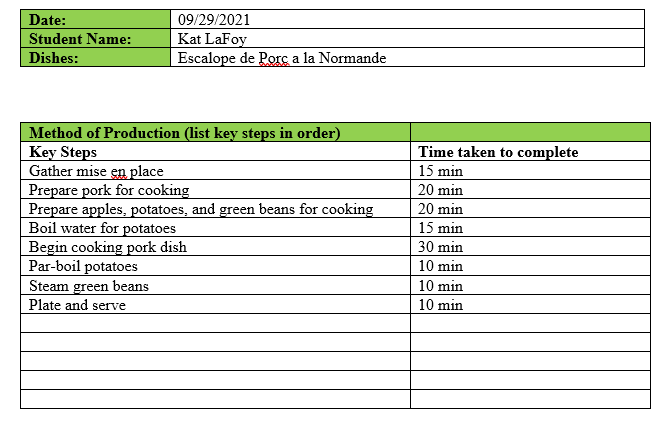
Plate Presentation:

Sources:


Reflection & Summary of Results
What Happened(?): Salty, salty, salty!!! The pork turned out tender, juicy, and delicious. However, due to my onion allergy, we used water in place of stock. We seasoned the water but didn’t think about the fact that our premixed seasoning had salt added to it. Using that in addition to the salt that the recipe called for created a bit of a seawater taste. The dish was good, but I drank about half a gallon of water that evening to keep my mouth from feeling like it was in a constant pucker. 😊

Evaluation: I would recommend doing away with the salt completely, and just adding a pinch to the completed dish. I like the green granny smith apples we used in the dish. We left the apple juice out that the original recipe called for to cut down on the sweetness factor. I would like to try using a sweeter apple in the future. I think a pink lady apple or a fuji apple will compliment the pork well. The sauce came together well, but broke when plated. I think I left it on the heat too long trying to hold it for plating, causing the butter and cream to separate.



Conclusions: I need to heat the sauce more slowly and try to plate as soon as it’s finished. I ground toasted almonds with a mortar and pestle to add some texture and a pop of flavor to the dish. The combination of almonds and apples worked well to bring the dish together.

I tried to find some pointers on how to save my sauce in the future. This is what I came across...
“You know your sauce is about to break when you see little fat droplets forming around the edge. If this happens, halt: Add a tablespoon or so of liquid and whisk vigorously until the sauce tightens back up. Then you can resume gradually adding your fat. If your sauce has broken completely, there is still hope. The Kitchn recommends whisking an egg yolk with a bit of whatever liquid you are using as the sauce’s base. Gradually add your broken liquid to the egg yolk mixture, one tablespoon at a time. In doing this, you’re forming a fresh emulsion. You could also add a tablespoon or so of heavy cream. Its high fat content should help stabilize the sauce. If your sauce is broken because it sat out too long at room temperature or you refrigerated it, don’t fret—this one's a pretty easy fix. Pour your sauce into a blender and add a tablespoon of very hot water, then blend until it’s smooth and creamy.” (Lamb, 2015)
“The sauce was kept warm for too long. Sauces are best served as close to serving time as possible. If you have to wait a while, it’s usually best to let the sauce cool to room temperature and then very gently re-heat it while stirring with a whisk or spoon.” (Christensen, 2008)
I think the dish as a whole was very well put together. This is something I will definitely be making at home for my family to try.



References
“Kitchen Rescue: How to Fix a Broken or Curdled Sauce.” Catherine Lamb. Food52.com. https://food52.com/blog/14876-kitchen-rescue-how-to-fix-a-broken-or-curdled-sauce. 24 November 2015.
“Food Science: Why Did My Sauce Break?” Emma Christensen. Thekitchn.com. https://www.thekitchn.com/food-science-why-did-my-sauce-46045. 25 March 2008


Comments