Week 7: Corn Fritters, Shrimp Wontons, & Fruit Stuffed Rice Rolls with Mango-Chili Dipping Sauce
- kelafoy
- Sep 29, 2021
- 7 min read
Updated: Oct 15, 2021
Introduction
Hors oeuvres, Appetizers, and Canapés are the star of the show this week! Who doesn’t love a tiny little bite of goodness to kick off a fabulous party or event? Let’s scroll along and see what we can learn today. 😊
Method of Cookery: “Hors d'oeuvres (pronounced "or-DERVS") are small one- or two-bite items that are served before dinner, usually accompanied by cocktails. As well, hors d'oeuvres may be served at a cocktail party where a full dinner is not being served. Hors d'oeuvres can be served at a table or passed on trays among guests. Note that the word appetizer is sometimes used interchangeably with the word hors d'oeuvres, which can lead to confusion in cases where the word appetizer is understood to mean the first course of a meal. There's no hard and fast rule, but in general, an hors d'oeuvre is served before a meal, and an appetizer is part of a meal.” (Alfaro, 2020)
Prior Knowledge of the Dish: My base knowledge of hors d’oeuvres is exactly that…just a base knowledge. I have always interchanged the idea of appetizers and hors d’oeuvres not knowing they were separate things. I learned in my food production class during the Spring of 2021 that there are multiple variations such as amuse bouche (to amuse the mouth), tapas, tea sandwiches, small plates, single bite tastings, sit down appetizers…the list goes on. What I didn’t know is that an hors d’oeuvre is an entity of its own. The key to a successful hors d’oeuvre is the planning that goes into it. You can have the most delicious bite prepared, but if the timing is off, the bite is held too long or not long enough, or even so much as a weak structure will cause a complete failure. An hors d’oeuvre is meant to be held in one hand and primarily eaten in one to two bites. You can spend months preparing a successful hors d’oeuvre for an event to have every bite disappear within the first hour or less. Needless to say, you always need to be prepared for the worst to happen and timing is everything.

Learning Objectives:
Compare and contrast appetizers and hors d’oeuvre
List the six requirements for successful hors d’oeuvres.
Identify foods frequently used for hors d’oeuvre preparations.
List and describe the five basic construction types of hors d’oeuvres.
Prepare a variety of cold hors d’oeuvres.
List and explain the four elements of hors d’oeuvre tray design.
Present hors d’oeuvres attractively on various types of service ware.
Background Information
Origin & History: “The origins of the hors d’oeuvre, strangely enough, have a theatrical foundation. A French word translating to ‘outside the work’, the hors d’oeuvre originated back in the 17th century, developing from a preceding incarnation called entrements. Translating to ‘between servings’ entrements were used in formal French dining back in the Middle Ages as elaborate forms of expression or display amongst the upper class. It was during the rigid symmetrical style of service à la française, introduced in the 17th century, when entrements began to change. Gradually they were served ‘outside the work’ of this system, generally appearing before the main meal as a canapé, a type of hors d’oeuvre of savoury items on small, toasted bread.” (Silva, 2017)
“A small number of food historians believe that the tradition may have begun in Russia, where small snacks of fish, caviar and meats were common after long travels. However, it may be that the custom originated in China, possibly coming through Steppes, into Russia, Scandinavia, France and other European countries. The tradition may have reached Italy, Greece and the Balkan nations through Russia or Persia. Many national customs are related, including the Swedish smörgåsbord, Russian zakuska, middle eastern mezze, and Italian antipasto. During the Roman Period the meal practice was to have two main courses which were supplemented before the meal with small amounts of fish, vegetables, cheeses, olives, and even stuffed dormice. These would be served at the start of the meal known as either gustatio or promulsis. The Greeks called the appetizer course propoma. As early as 500 CE, the Babylonian Talmud (Yoma 83b) recounts the practice of feeding sweet desserts to a person before the main course of a meal in order to revive his strength and increase his appetite.” (Wikipedia, 2021)

Methods Used: “Cultures and cuisines throughout the world offer many variations of small plates of food. From street carts and food trucks to fine dining restaurants, and every type of establishment in between, small plates are popular. Hors d’oeuvres are "apart from the main work" and served before sitting down to meal service. They may be hot or cold items. Because they are usually eaten while standing, hors d’oeuvres should be finger food that can be eaten without the use of utensils.” (Culinary Pro, 2021)
Dish Variations: “There are a few general categories of hors d'oeuvres. Canapés are a type of hors d'oeuvre constructed of a base of bread, pastry, crackers, or something similar, with some sort of spread such as flavored cream cheese or butter, and then a topping. The topping can be practically any sort of meat, seafood, vegetable, fruit, and so on. Think of crab and avocado toasts, bruschetta with olive tapenade and mushrooms, or toasts topped with tuna and red pepper mousse. Another sort of hors d'oeuvres would be small items served on a skewer, stick, or toothpick such as grilled shrimp, satay beef skewers, or cheese and fruit kebabs. These can be artistically arranged, alternating items for color as well as a blend of flavors, or the sticks can be dedicated to one item. Small pastry shells filled with some savory or sweet ingredient would also be a type of hors d'oeuvre. An elegant example is caviar and creme fraiche tarts, while a simple one would be mini-quiches. Small fried items such as turnovers, empanadas, samosas, and egg rolls are often served with a dipping sauce. Crudité platters (cut raw vegetables served with a dip) or even dips served with crackers or chips can be considered hors d'oeuvres as well. Indeed, a simple bowl of nuts would be hors d'oeuvres if served with drinks before dinner. Think of a dish of citrus-marinated olives served with crackers or gougeres. Deviled eggs are a classic, crowd-pleasing hors d'oeuvre that has many variations. There's really no limit to what sort of item can be considered an hors-d'oeuvre, provided it is small (one to two bites) and is served before dinner or in place of dinner at a cocktail party.” (Alfaro, 2020)

References
“Garde Manger.” Culinarypro.com. https://www.theculinarypro.com/hors-doeuvres. 2021.
“Hors d'œuvre.” Wikipedia.com. https://en.wikipedia.org/wiki/Hors_d%27oeuvre. 2021.
“The Origins of “Hors d’oeuvre.” Dean Silva. https://todaysworldkitchen.com/2017/08/03/the-origins-of-hors-doeuvre/. 03 August 2017.
“What Are Hors d'Oeuvres?” Danilo Alfaro. https://www.thespruceeats.com/what-are-hors-doeuvres-995716. 17 September 2020.
Dish Production Components
Recipes:


Plan of Work:

Plate Presentation:

Sources:

https://www.eatwell101.com/corn-fritters-recipe


Reflection & Summary of Results

What Happened(?): This week was pretty darn fun. I got to create a dish I have never made before. We had multiple items on the agenda this week, and for time-saving purposes we split up our workload. My focus this week was the shrimp wontons. I have NEVER been able to correctly wrap a wonton successfully. Thankfully, one of my classmates has a ton of experience in this area and was able to show me the proper technique. My wontons aren’t nearly as beautiful as hers, but with more practice I believe I can master it. My first attempt compared to my last shows a drastic difference. 😊 I originally tried to use the scrunch method. “This method is used only with very thin wrappers and small amounts of filling. It involves simply squeezing the wrapper around the filling. We use this method for small Shanghai-style wontons in soup.” (Sarah, 2020) My version of the scrunch was just plain ugly, and it fell apart when cooking. You can see it here…

Food Cost: I based my food cost on the recipe I focused on this week.

Evaluation: WONTONS ARE HARD!!! I have a new respect and appreciation for the skill it takes to prepare wontons and spring rolls. The technique we used in class was the bonnet. “The Bonnet: the most common method, perfect for wontons using regular white wrappers that will eventually be boiled and mixed into soup or sauce.” (Sarah, 2020) The recipe said to steam the wontons, but frying them gave them a much better color, and made the texture more palatable. We paired it with a mango-sweet chili dipping sauce, that added more depth of flavor to the dish.
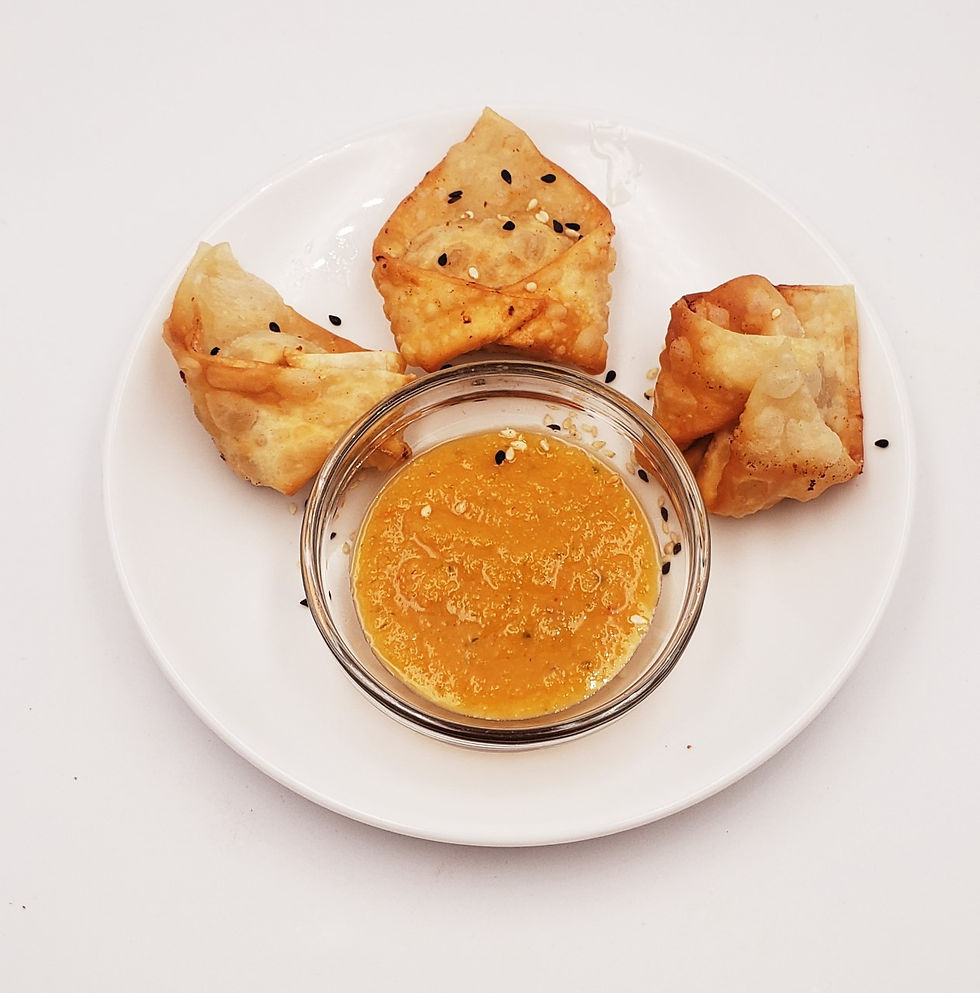
Conclusions: The shrimp wonton recipe left a little something to be desired in the flavor department. It was quite bland. I plan on practicing my folding technique at home. When I do, I want to add some spice to the filling to give it a little more kick. I have considered using chili oil or chili paste…maybe even a dash of cayenne pepper. Had we not had the dipping sauce with it, it would have needed more body to round out the flavor of the filling.





Rice paper roll wrappers are sticky and feel kind of rubbery when eating them. They are also very difficult to work with. If you don’t pull the wrapper tightly around the filling, they can look messy. However, they can be beautiful when done correctly. The key to a great presentation is to place the focal point of the filling in the bottom of the wrap before rolling it, and wrap it as tightly as possible without it breaking. I think we should have tried putting a little less filing in each roll in addition to tightening the wrap. The avocado salsa that was paired with the rice paper rolls was AMAZING!




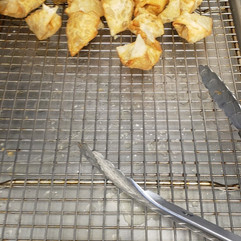
The corn fritters were my favorite today. The crispy texture with the creaminess of the center was a perfect balance. I have read that using frozen corn can cause them to be gooey. “Fresh corn definitely makes for a thicker, more workable batter!!” (Chunky Chef, 2016) Ours didn’t seem to have that effect. I think it may have been due to the fact that the frozen corn was tossed in the dry ingredients first, without being thawed. This kept it from getting that wet flour texture. They were delicious with and without a dipping sauce. I liked the mango chili sauce so much though, that I dipped everything in it. 😊


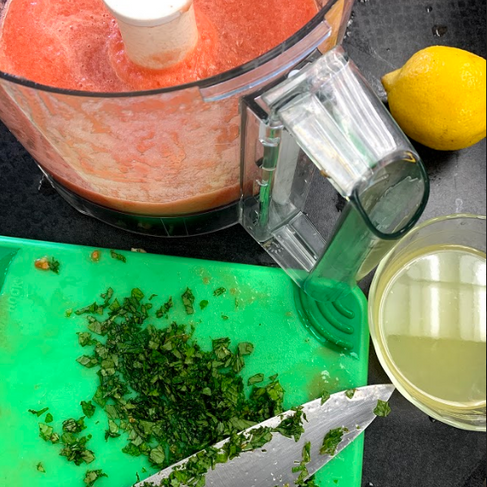
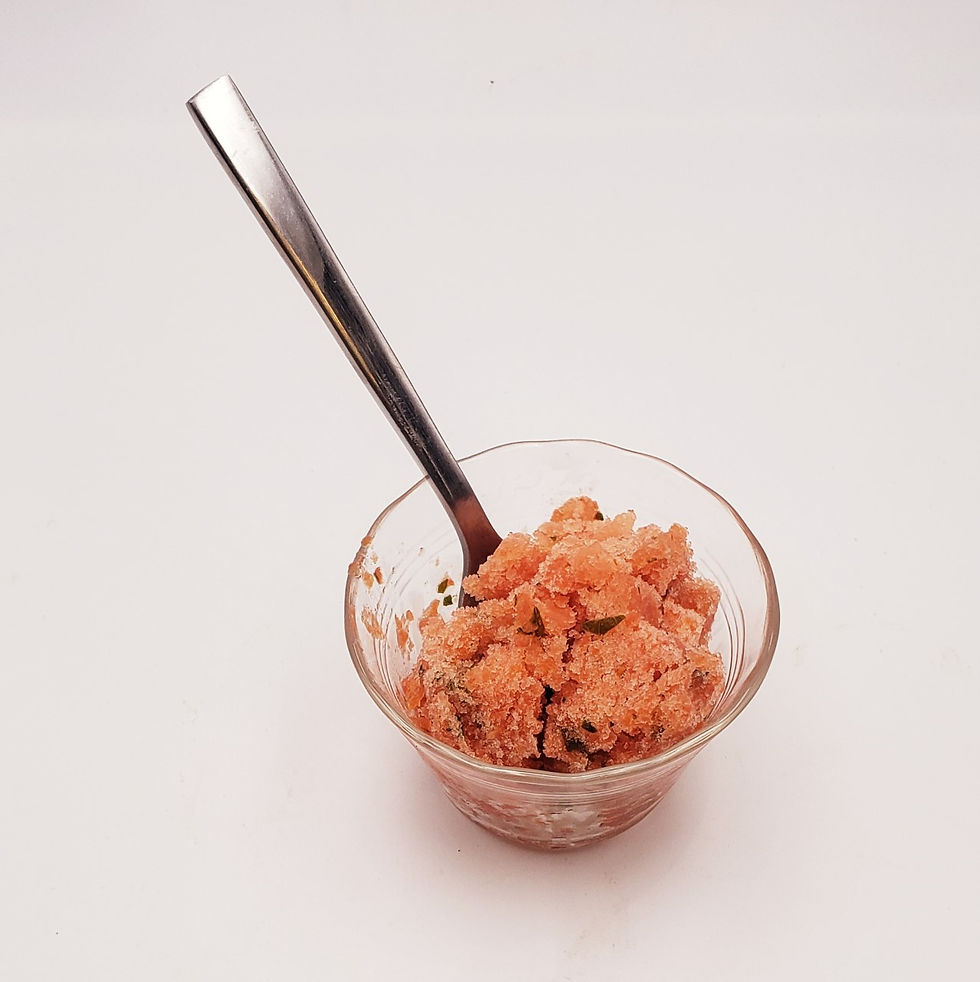
We also created a tomato basil sorbet. I was unsure about trying this. We don't really think of tomatoes as being a dessert item. However, a ripe tomato can be quite sweet. It was different for sure. 😊 I can't say it's something I'd like to eat again. It wasn't bad...just not my cup of tea, so to speak.




There will not be a week 8 post for this class, since we are out for Fall Break. Make sure to check back in for Week 9. We are trying a plant-forward menu, and I for one am super excited about it. 😊
References
“How to Fold Wontons.” Sarah. https://thewoksoflife.com/how-to-fold-wontons/. 17 August 2020.
“Sweet Corn Fritters with a Spicy Aioli.” The Chunky Chef. https://www.thechunkychef.com/sweet-corn-fritters-spicy-aioli/. 14 July 2016.


Comments