Week 11: Terrines, Pâtés, Roulades & Galantines
- kelafoy
- Oct 27, 2021
- 6 min read
Updated: Oct 29, 2021
Introduction
Forcemeat and Terrine…doesn’t sound that appealing, does it? 😊 Forcemeat is actually something we eat a lot of. Think sausage, bratwurst, meatloaf wrapped in bacon…see where I’m going with this? Let’s keep scrolling to get a little more detail shall we.
Method of Cookery: “Dictionary.com indicates forcemeat is a cookery noun and defines it as, ‘a mixture of finely chopped and seasoned foods, usually containing egg white, meat or fish, etc., used as a stuffing or served alone.’ That’s fine for a beginner definition, but let’s move into a culinary definition suitable for a home cook who’s getting into forcemeat. In Garde Manger: The Art and Craft of the Cold Kitchen, Fourth Edition, The Culinary Institute of America, gives a precise definition of forcemeat. They say, ‘A forcemeat is a lean meat and fat emulsion that is established when the ingredients are processed together by grinding, sieving, or puréeing. Depending on the grinding and emulsifying methods and the intended use, the forcemeat may have a smooth consistency or may be heavily textured and course. The result must not be just a mixture but an emulsion, so that it will hold together properly when sliced.’” (Bassett, 2021)
“Terrines are usually served cold or at room temperature. Most terrines contain a large amount of fat, although it is often not the main ingredient, and pork; many terrines are made with typical game meat, such as pheasant and hare. In the past, terrines were under the province of professional charcutiers, along with sausages, pâtés, galantines, and confit. Less commonly, a terrine may be another food cooked or served in the cooking dish called a 'terrine'.” (Wikipedia, 2021)
Prior Knowledge of the Dish: Prior to lecture today, I had no idea what forcemeat was. Little did I know that my family’s favorite bacon wrapped meatloaf is considered a forcemeat terrine. Also, the Carne Fria we made in week 3 is a forcemeat. How cool is that?! I already knew what it was without ACTUALLY knowing what it was. 😊 The terrine pretty much describes the dish / shape it is in. I’m excited to work on the Pâté en croûte and try my hand at that. I have done something similar at home but wasn’t aware I needed aspic to fill the space in my pastry. I now understand why it always falls apart when I make it at home. That’s why I’m here though right…to learn and hone my craft.
Learning Objectives:
· Explain the use and preparation of forcemeats
· Identify various types of forcemeats including straight, country-style, gratin, and mousseline
· Describe the procedure for making terrines
· Understand how to prepare pâté en croûte
· Explain the process of making galantines and roulades
· Recognize proper method of working with foie gras including grading, cleaning, and marinating
· Provide examples of nontraditional “terrines” made without forcemeats
Background Information
Origin & History: “Forcemeats are an ancient food and are included in Apicius, a collection of Roman cookery recipes usually thought to have been compiled in the late 4th or early 5th century AD.” (Wikipedia, 2021)
“The word Terrine dates back to the Middle Ages and in French it simply describes an earthenware dish. Terrine has the same origin as the English tureen, meaning something made from earth, of Terra. Terrin or therin (15th Century) means earthen and comes from Latin terrenus or terra 'of the earth'. China earthenware is also known as terracotta (french terre cruite). Over time, the use of the word terrine has been extended to describe the food which is cooked in the dish we now know and describe as Pâté (/pæˈteɪ/). Terrines or Pâtés were known to the Romans, Greek and French as early as the 11th century. In ancient Greece, Athenians sold Pâtés at the market along with other meats. It was mostly a way to make more money by utilizing and selling every part of the animals they used. But really it was the French who for a large part were trying to find a way of preserving meat and fish to last throughout the year. Back in the old days the pâtissier (pastry chef) would be in charge of the Pâté making. What started with just ground mince mixed with spices, cooked and eaten cold out of a Terrine evolved into Pâtés by wrapping several meats into a dough. The dough was a cover up to hide all the meat leftovers that have been used originally to make it look more appetizing and appealing. Pâte means 'dough' and Pâté was originally baked in a crust (Pâté en croûte) to keep everything together.” (Craft Pâté, 2021)
Methods Used: “There are a few basic styles that are classic to forcemeat preparation including a rustic textured campagne or country-style and a straight forcemeat which is smoother with a more refined texture achieved by the progressive grinding of the ingredients. A gratin forcemeat is created by fully or partially cooking the proteins before processing and is commonly prepared with pork or poultry livers. A Mousseline forcemeat is a light and delicate forcemeat made by emulsifying the ingredients with eggs and cream. A 5/4/3 emulsion forcemeat refers to the ratio of ingredients, 5 parts lean meat, four parts fat, and three parts ice used to make emulsified sausages like bologna and frankfurters.” (Culinary Pro, 2021)
Dish Variations:
“Modern terrines do not necessarily contain meat or animal fat, but still contain meat-like textures and fat substitutes, such as mushrooms and pureed fruits or vegetables high in pectin. They may also be cooked in a wide variety of non-pottery terrine moulds, such as stainless steel, aluminum, enameled cast iron, and ovenproof plastic.” (Wikipedia, 2021)
References
“Forcemeat.” Wikipedia. https://en.wikipedia.org/wiki/Forcemeat#:~:text=5%20Notes-,History,or%20early%205th%20century%20AD.. 2021.
“Forcemeats.” The Culinary Pro. https://www.theculinarypro.com/forcemeats. 2021.
“Forcemeat 101: A Beginner’s Guide to Meat Emulsions.” Andrea Bassett. https://forcemeatacademy.com/forcemeat-101-beginner-guide-to-meat-emulsions/. 2021.
“Once Upon A Time.” Craft Pâté. https://www.craftpate.co.nz/history. 2021.
“Terrine (food).” Wikipedia. https://en.wikipedia.org/wiki/Terrine_(food). 2021.
Dish Production Components
Recipes:


Plan of Work:
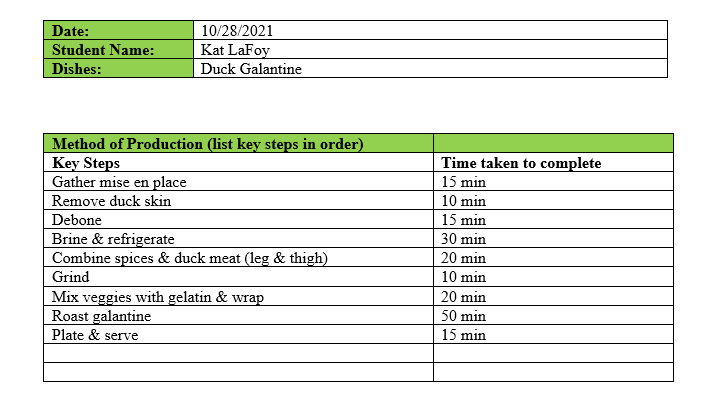
Plate Presentation:

Sources:


Reflection & Summary of Results
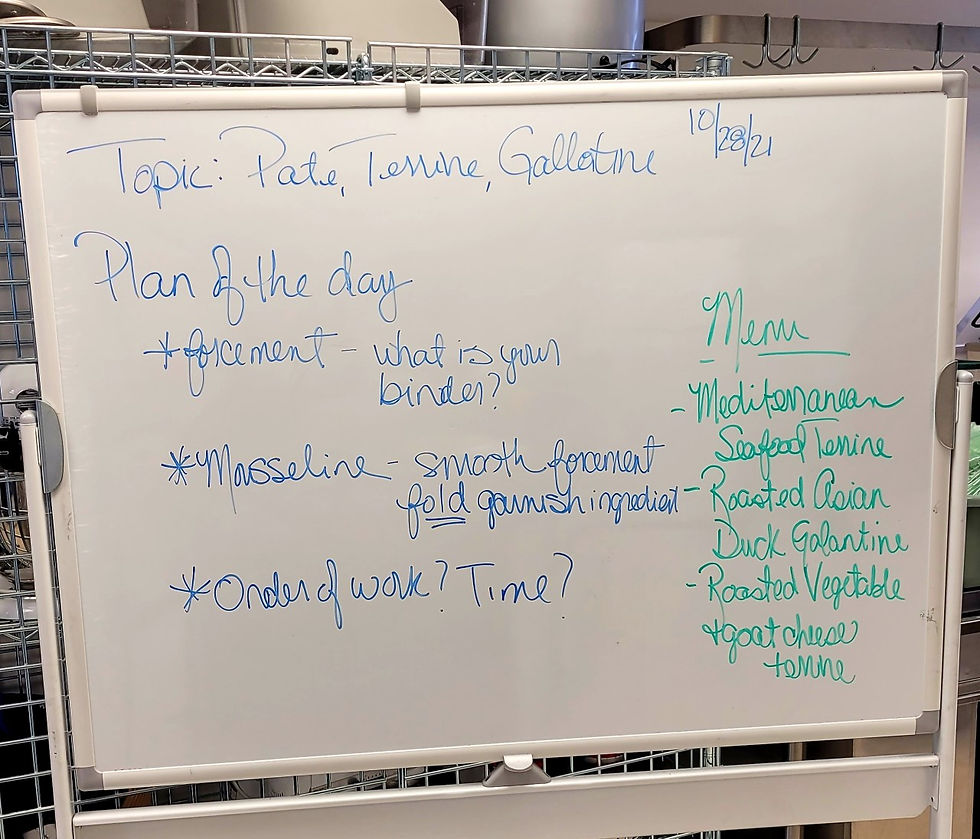
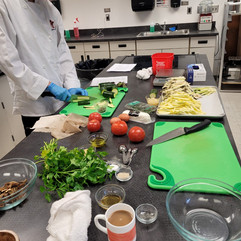
What Happened(?): I had every intention of making the duck this week but when we broke into pairs in the lab, I was set on the vegetable terrine. I have never made one before and it seemed like a fun dish to create. Magen and I created the roasted vegetable terrine, and I made a tomato/basil gelatin with the tomato cores to go under the terrine when plating. We are trying to create as little food waste as possible, and I thought this would be a great flavor compliment to our dish. Alena and Celine made the duck galantine and Sophia, A.P., and Will created the seafood terrine.




Food Cost:

Evaluation: The duck galantine was a lot harder than anyone expected it to be. The skin became quite rubbery and it was chewy, for lack of a better term. The flavor was nice, but the texture was unpleasant. I found another recipe that called for using the entire duck (deboned) and braising it in stock made from the innards. “Place deboned duck, skin down, flat open on a cutting board. Rub garlic and salt into meat, sprinkle with cumin, coriander, pepper, and walnuts. Wrap duck together to resemble the whole bird. Tie bird up (again, refer to the technique Jacques shows brilliantly in his video). In a preheated pan with a little olive oil, on a medium heat, cook duck on a one side until golden brown. Using tongue and spatula, turn bird over and cook on another side until golden brown. Add 1-2 cups of stock from your pot with duck leftovers. Cover pan with duck and stock tightly with a lid, switch heat to lowest setting and let it braise for 1.5-2 hours. Turn heat off and let duck to cool down completely.” (DK Challenges, 2013) If we had more time in lab, I think this may have been a better technique to try.

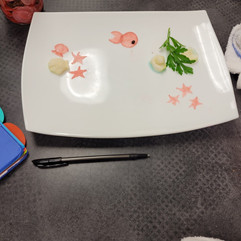
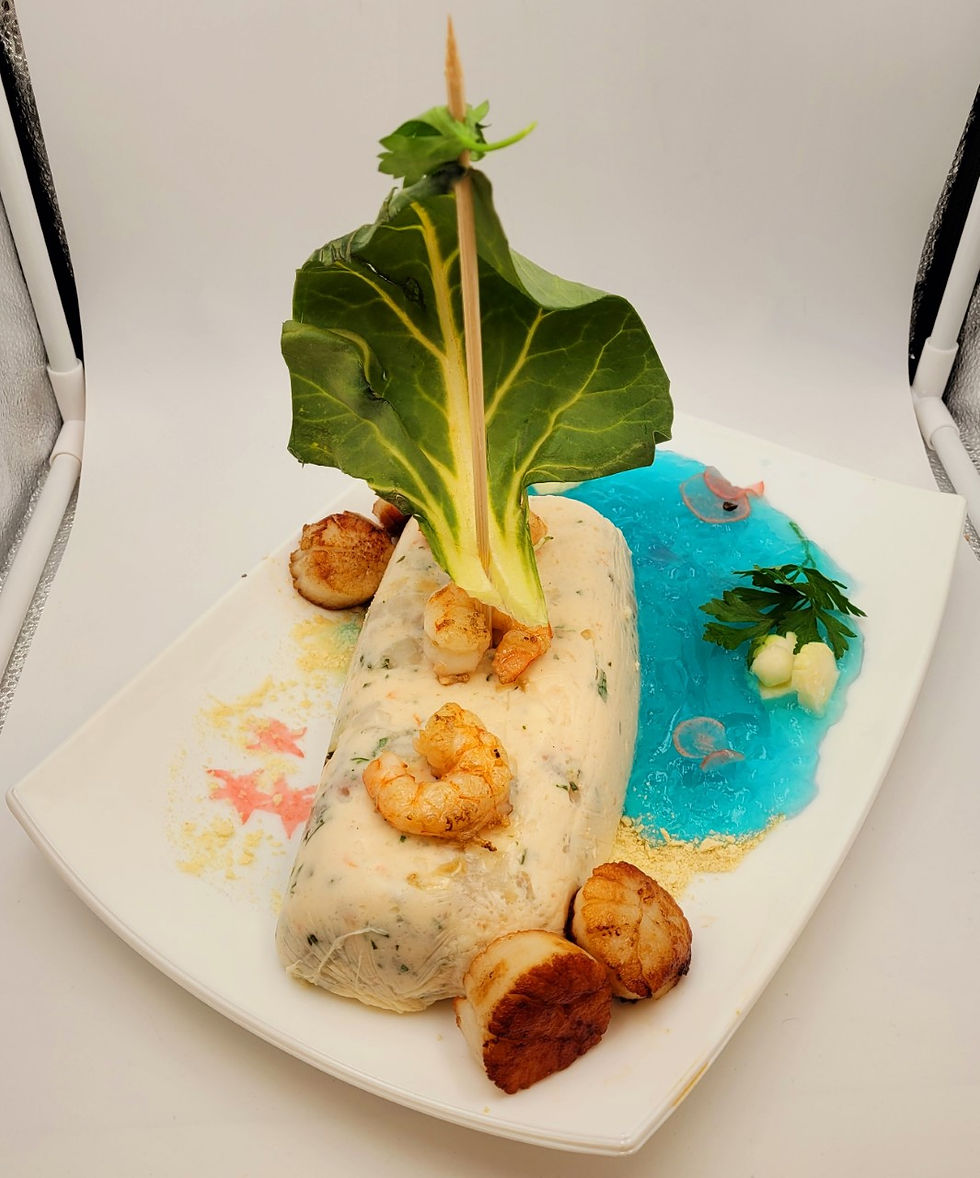
The seafood terrine turned out beautifully. They got very creative with the plating and created a seaside appearance. I didn’t get to taste it due to the onions in it, but it looks amazing.
The veggie terrine was packed a little tightly and kind of watery. I don’t think we roasted the veggies long enough to dry them out. “Another problem with using a mousseline is that the terrine has to be cooked. Because vegetables can’t be added to a terrine raw (they’ll release too much water), using a mousseline means you have to cook the vegetables twice.” (Peterson, 1996)

Conclusions: Our roasted vegetable and goat cheese terrine needed much longer to cool. We were limited on time, and it is recommended to refrigerate it overnight. We had it in the freezer for about thirty minutes which didn’t do it justice. The tomato/basil gelatin also needed a little longer in the refrigerator. It appeared that someone’s finger got into the gelatin, so I placed sliced figs on the plate for a nice little pop of color. I think it did well to hide the divot as well.

References
“Duck galantine.” DK Challenges. http://effortnesslessly.blogspot.com/2013/04/duck-galantine.html. 15 April 203.
“Layering Flavors in a Vegetable Terrine.” James Peterson. https://www.finecooking.com/membership/pdf/43274/051015061.pdf. June / July 1996.


Comments