Week 12: Visit to the Auburn University Meat Lab
- kelafoy
- Nov 3, 2021
- 5 min read
Updated: Nov 4, 2021
Introduction
This week we will be attending class in the meat lab. Below are our learning objectives for this week’s module, as well as information from the Power Point slides shown in class which were written and presented by Chef Ana Plana.
Learning Objectives:
· describe the structure and composition of meats
· explain meat inspection and grading practices
· purchase appropriate meats
· store meats properly
· prepare meats for cooking
· apply various dry-heat, moist-heat, and combination cooking methods to meats
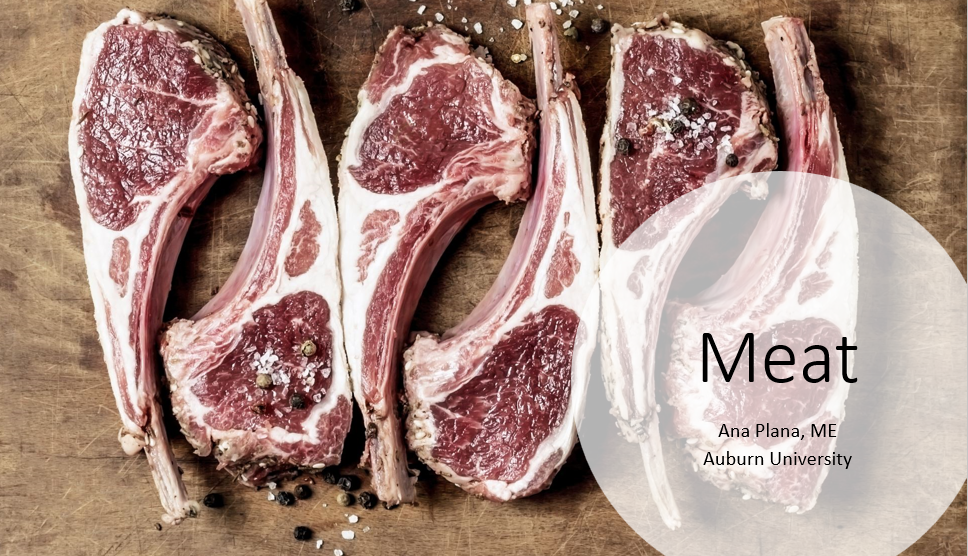
Red meat flesh from furred animals consists of lean muscular tissue, connective tissues such as collagen that dissolves when cooked in a moist environment, and elastin which is primarily protein based but too tough to be edible, along with fat and bones.
The size and thickness of the cell walls, the size of the cellular muscle bundles and the collagen that holds them together form a type of matrix or grain of the meat. This will tell you what type of texture the meat will have. When the fiber bundles are small, the meat has an almost velvet-like, fine grain texture. Grain also refers to the directionality of the muscle bundles.
Collagen is a protein-based substance that is water soluble. It is the soft connective tissue between muscles. It is tenderized by acids and renders down in the presence of low heat and moisture into gelatin and water. In preparing products such as aspic, headcheese or other heavily aspic-based products, it is good to know which cuts work best for these processes.
Elastin is protein-based, golden-colored, ropey connective tissue that is not broken down by heat or moisture. Mechanical chopping of these fibers or total removal is the only way of tenderizing a food product.
Veal:
Veal is the meat of young, usually male, calves that are by-products of the dairy industry.
Young veal has a firm texture, light pink color and very little fat.
Veal’s delicate flavor is complemented by both classic and modern sauces.
The veal carcass can be split down the backbone into two halves
OR
Veal carcass can be cut between the 11th and 12th ribs into these two sections:
· Fore saddle
· Hind saddle

Goat:
Goat is closely related to lamb.
Most goats are bred for milk and cheese production.
Goat is consumed in 75% of the world.
Goat may be roasted whole or split or stewed.
Lamb:
Australia and New Zealand account for 50% of lamb sold in U.S.
Domestic lamb is primarily grain-fed and has a milder flavor than grass-fed imported lamb
Domestic lamb is raised to around 135 pounds, larger than imported lamb resulting in larger cut sizes
Cooking time may take twice as long for domestic rack of lamb as when cooking imports



Pork:
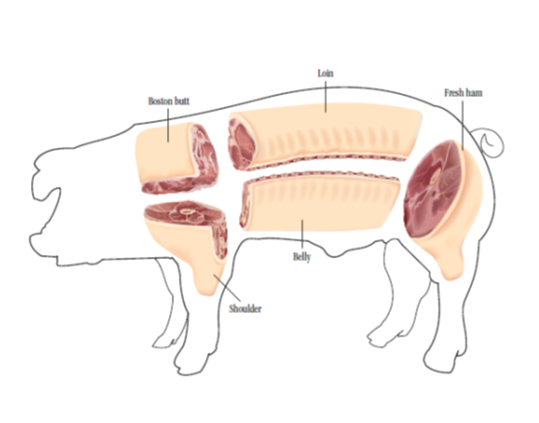
The primal cuts of pork consist of the Boston butt, loin, fresh ham, belly and shoulder.
Most pork is processed into cured products such as bacon and ham.
In the United States, pork is second only to beef in meat consumption.
Pork is pale pink to light red in color; and, like all animals, its flavor can be enhanced by what type of feed it receives.
Game:
Furred game includes large animals such as:
· Antelope
· Bison (American buffalo)
· Deer (Venison)
· Moose
· Bear
· Wild boar (closely related to domestic hog)
· Elk
Furred game includes small animals such as:
· Rabbit
· Squirrel
· Raccoon
· Opossum
The meat grading program is administered by the U.S. Department of Agriculture (USDA). Beef quality grades indicate palatability characteristics such as tenderness, juiciness, and flavor.
Inspection
By law, all meat must be inspected and passed for wholesomeness by the USDA
Grading
Quality grading is voluntary. Prime, Choice and Select are the most common quality grades consumers see.

There are several levels of quality grading with beef, veal, pork and lamb.
Beef: USDA Prime (Figure 6-102), Choice, Select, Standard, Commercial, Utility, Cutter and Canner
Veal: USDA Prime, Choice, Good, Standard, and Utility
Pork: USDA No. 1, No. 2, No.3 and Utility
Lamb: USDA Prime, Choice, Good and Utility

Beef:
After cattle is killed, skinned, eviscerated, and inspected, the remaining meat, bones and fat are called carcasses. When the carcasses pass inspection, they are then broken down into halves, then quarters, and then to the primal cuts and fabricated cuts. These fabricated cuts include sides, quarters, fore saddles, and hindquarters or saddles.
Primal cuts are the wholesale cuts that are cut to industry standards. A system was devised by the meat industry to standardize all meats sold in the U.S. The NAMPS guidelines codified all meat primal, sub-primal and fabricated cuts.
Sub primal cuts are cut from a primal down to a more manageable size.
Fabricated cuts such as roasts, steaks, chops, cutlets, stewing meats, ground meat and so forth as set forth by the IMPS/NAMPS specifications are even smaller cuts for foodservice.




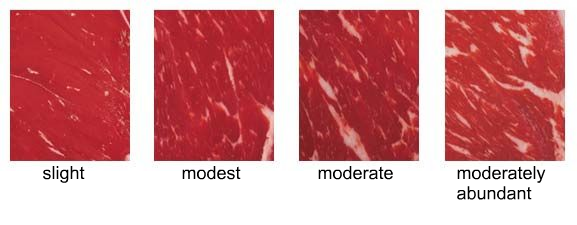
Marbling: How fat affects flavor
Fatty acids (the building blocks of fat) experience chemical changes during cooking and produce potent flavor compounds
Fat acts as a storehouse for aromatic compounds that are released during cooking
Many beef flavor components are found in these aromatic comp
Reflection & Summary of Results
Today was ssssoooo cool!!!!! We spent a little time in the instructional classroom getting to know Barney Wilborn, the professor at the Lambert-Powell Meats Laboratory at Auburn University. "The Auburn University Lambert-Powell Meats Lab is a state of the art teaching, research & extension facility supporting a variety of activities in the areas of meat quality, meat processing & food safety for the Department of Animal Sciences."



The meat lab is housed under the umbrella of Animal Science in The College of Agriculture, not including Poultry Science. The primary degree options studying in this facility are Veterinary, Equine, and Meat Science. We had such a fantastic learning experience today that we have requested for the Culinary Science option faculty to discuss a class at the meat lab as a professional elective course for our program. We donned these super cute hair nets...

… some cool hard hats...

… and decked ourselves out in protective lab gear to keep any unwanted germs or stray hairs from touching the meat / meat products...

We got to see how to break down and butcher half a hog, learned the difference in the various cuts of meat, how they are processed, and what part of the pig they come from. We visited the smoke room where they were smoking Bratwurst, Summer Sausage, and Andouille Sausage. Then, Professor Wilborn gave us the great honor of hands on sausage making as well. We helped season, grind, and case Bratwurst (50 pounds) and breakfast sausages (25 pounds). Let me tell you...it isn't nearly as easy as one might think. The primary casings used for these purposes are collagen and pork casings. We used sheep casings when we created the Irish Sausage during week 3 in our lab and had an issue with the casings bursting when cooking. We found out today that the reason for that is how delicate sheep casings are. They tend to rip easily. We also learned that...surprisingly...salt is the best binding agent when creating sausage. The salt breaks down the protein and creates a better texture than a moist binder such as eggs or fat would. I don't have any photos from inside the meat processing lab. Cameras are not allowed in that part of the facility...understandably so. I did however, get pictures of some of the cows with their precious babies as we were leaving.


If you are ever in Auburn and want fresh / local meats for you dinner table at home, I would highly recommend stopping by The Auburn University Lambert-Powell Meats Lab. "Products produced under inspection are available to the general public in the Retail Sales Room which is open from 2–5 PM Monday through Thursday and 11 AM – 5 PM on Friday. There is a variety of fresh pork and beef as well as bacon, different varieties of sausage, and on occasion a selection of BBQ, smoked brisket, and hams."
You will not be disappointed. 😊


Comments