Week 6: Pan-fried Chicken, Dauphinoise Potatoes, & Ratatouille
- kelafoy
- Oct 19, 2021
- 8 min read
Updated: Oct 22, 2021
Introduction
I like to call this week “Get in My Belly” week. 😊 You can’t go wrong with pan fried chicken, and that’s the star of our dish this week. We will also be creating ratatouille and dauphinoise potatoes. I’m drooling over here!!!
Method of Cookery: “For this week, we will be frying food. Frying is defined as cooking foods using fat as a lubricant and or as a conductor of heat. Frying foods is considered a dry cooking method. There are four basic frying techniques: (i) sauteing, (ii) pan frying, (iii) stir-frying, and (iv) deep frying. All the methods of frying are rapid cooking methods requiring high heat and very tender cuts of meat and vegetables. Fried food is typically characterized by browning of the outside of the meat or vegetable producing a characteristic caramel flavor. It is important to select the right fat or oil to cook the food in, many fats have a low smoking point which is undesirable.” (Canvas, 2021)
Prior Knowledge of the Dish: Pan fried chicken is a regular thing in my house. What good Southern girl doesn’t fry chicken? 😉 I’ve never made or eaten ratatouille before and prior to today, I have never heard of dauphinoise potatoes. The potato recipe sounds super yummy, and it’s definitely something I will be adding to my list of things to cook for my family. Starch and cheese…YES PLEASE!
Learning Objectives:
· Identify the structure and composition of poultry.
· Prepare poultry for cooking using deep and shallow frying
· Demonstrate an understanding of the principles of plate presentation
Background Information
Origin & History: “Ratatouille is a classic Provencal French vegetable stew recipe. The word ratatouille is derived from the Occitan term “ratatolha” and the French words “rata” meaning chunky stew and “touiller” which means to toss food or stir up. Originating in the 18th Century in the Provencal region of Nice, it is known as a peasants stew created by poor farmers that needed to use up the harvest of the fresh summer vegetables that had ripened all at once and were ready to eat from the garden.” (Stradley, 2021)
“The American English expression "fried chicken" is first recorded in the 1830s, and frequently appears in American cookbooks of the 1860s and 1870s. The origin of fried chicken in the southern states of America has been traced to precedents in Scottish and West African cuisine.” (Wikipedia, 2021)
“The Dauphinoise potatoes, also called Gratin Dauphinoise, is a traditional dish typical of Southern France. The first written news about the Dauphinoise is dated 12 July 1788 in the report of a dinner for the municipal officials of the city of Gap.” (Trapella, 2020)
Methods Used: “For this week, we will be using two of these methods; pan frying and deep-fried. Later in the semester we will do the other two methods. The difference between pan frying and deep frying is the amount of oil or fat that is used. With pan frying food is cooked in enough fat or oil to cover about half of the thickness of the food in a pan. Deep frying on the other hand is typically conducted in a deep fryer where the food is fully immersed in the hot fat or oil.” (Canvas, 2021)
Dish Variations: “You will find many different versions of ratatouille using these key ingredients and there is also different schools of thought for proper cooking of ratatouille:
One method is to sauté all the vegetables together at once until they are cooked down.
A second option is to cook the zucchini and eggplant separately then combine them together at the end with the onions, tomatoes, and bell peppers for the final stewing. Then finish by baking in a casserole dish.
Another method is to cook the vegetables in a layered method, starting with caramelizing the onions and garlic, then adding the eggplant to cook down and then finally adding the zucchini, tomatoes, bell peppers, and fresh herbs to stew everything together.
A more contemporary version is to slice the eggplant, squash and bell peppers thinly and layer in a casserole dish for baking.” (Stradley, 2021)
“Scottish fried chicken was cooked in fat (though unseasoned) while West African fried chicken was seasoned (but battered and cooked in palm oil). Scottish frying techniques and African seasoning techniques were used in the American South by African slaves. Fried chicken provided some means of an independent economy for enslaved and segregated African American women, who became noted sellers of poultry (live or cooked) as early as the 1730s. Because of this and the expensive nature of the ingredients, it was, despite popular belief, a rare dish in the African American community reserved (as in Africa) for special occasions.” (Wikipedia, 2021)
“The Gratin Dauphinoise is also an excellent base to prepare tasty variations mixing one or more of these ingredients:
CHEESE: adding medium hard cheese like Gruyere or Fontina grated between the potato layers and on the top.
MEAT: for instance, ham, or bacon.
OTHER VEGETABLES: like sliced mushrooms, or zucchini, or asparagus.” (Trapella, 2020)
References
“DAUPHINOISE POTATOES RECIPE: FRENCH POTATOES AU GRATIN - ALL YOU NEED TO KNOW!” Filippo Trapella. https://philosokitchen.com/dauphinoise-potatoes-au-gratin/. 2020.
“Fried chicken.” Wikipedia. https://en.wikipedia.org/wiki/Fried_chicken. 2021.
“Ratatouille Recipe and History.” Linda Stradley. https://whatscookingamerica.net/soup/provencal-ratatouille.htm. 2021.
“Week 6: Week 6 Overview.” Canvas. https://auburn.instructure.com/courses/1381074/pages/week-6-week-6-overview?module_item_id=20251748 . 2021.
Dish Production Components
Recipes:


Plate Presentation:

Sources:


Reflection & Summary of Results
What Happened(?): Unfortunately for me, Covid is still happening. I am one lucky gal though. I have an awesome classmate willing to share his blog reflection with me. We’re going to peek into the world of pan-fried chicken and see what happened in class this week through Dallas’s eyes. The words and photos below are from his blog.
"Did the cooking technique work or not?
Overall the vast majority of the cooking techniques worked great but as always some didn't work as well. But, with any recipe this will happen and its good to learn what worked and what didn't work.
How did the dishes turn out in terms of:
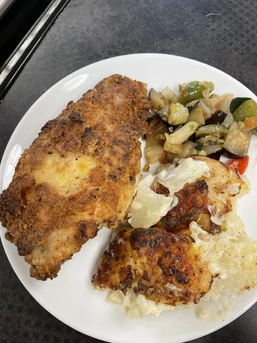
Pan-fried Chicken
Texture
The texture of the chicken was awesome. It was congruent throughout and was moist as could be. Although the inside was moist the outside had an amazing, firm, and crunchy fry.
Taste
The taste of the chicken speaks for itself. It delivered a great and formidable taste that you expect with chicken. The seasoning we added to the flour contributed a wonderful taste that was salty, pronounce, and herby.
Flavor
` With the combination of the taste of the chicken and seasoned flour we obtained an amazing pieces of pan-fried chicken that was delicate, delicious, and filling.
Appearance

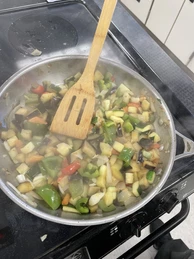
Ratatouille
Texture
This dish came out awesome. It had a soft and squishy texture that came from the zucchini and eggplant. But also had a firm crunchy texture from the peppers and unions. Furthermore, the zucchini and eggplant had a firm outside edge that made it all come together nicely.
Taste
The taste from the peppers and union stuck out to me the most in the dish. The peppers gave off an earthy, light, and healthy taste that you look for. The union as well gave off a sweet and acidic taste that was much needed. The taste of the garlic popped a little as well in the dish. Its taste wasn't a smack you in the mouth but the hint of the garlics pungent and sweet taste worked very nice.
Flavor
The flavor of the ratatouille was very good due to the amount of flavors contributed by its many ingredients. The peppers, zucchini, eggplant, contributed an healthy, rich flavor that complemented the garlic and union amazingly. The white wine we used to de glaze the pan contributed a much needed bitter flavor. Lastly, the tomato cancassée contributed an acidness to the flavor of the dish that complemented every ingredient great.
Appearance
Dauphinoise Potatoes
Texture
The texture of our potatoes was very mediocre due to them not being cooked to perfection. The outside of the potato slices was what you want but the inside was hard which was unpleasing. The texture of the cheese on the other hand was awesome since it was mushy and gushy. When attempting to take a bite of cheese it would string out from your plate to the fork.
Taste
The potatoes taste is obviously one that stuck out the most. The potatoes gave off a starchy, wholesome, and filling taste. The gruyére cheese taste was rich, creamy, and salty. The taste of the garlic wasn't so prominent in the dish but it's pungent taste popped out here in there.
Flavor
Although the potatoes weren't cooked enough the flavors were awesome. The potatoes, gruyére cheese, and garlic created a uniform flavor that was delicate and rich. The garlic mixed well with this delicate and rich flavor because it added a pungent and sweet flavor.
Appearance

Results
Why did certain techniques work or not work?
I had a blast during this lab since I had prior skills and knowledge that helped everything go smoothly. A couple techniques worked flawlessly and some not as great. The technique behind cooking the chicken worked great. We established a great outside crust along with a moist and juicy inside which is ideal. It worked so well because we fried the chicken at the perfect temperature which allowed for a crunchy fry but didn't dry out the inside. To keep the good times going our ratatouille technique worked awesome. We sautéd the vegetables to perfection a had a great brown outside. We utilized wine as a de glazer and it worked to perfection. This all allowed for optimal flavor extraction, presentation, and texture. Now on the sad side of things, the technique behind the potatoes was flawed. We found that the amount of potatoes as too much for the amount of cream. This was due to there not being an exact weight of potatoes to use. This didn't work because not all the potatoes were covered in cream so the cooking consistency was flawed. The previous problem also contributed to the potatoes not being cooked throughly. A lot of them were hard in the middle which was unpleasing.
What could/would you do to improve the outcomes?
To improve the outcome of the overall meal I produced I would only change the potatoes. The first thing I would do next time would be to add more cream to the potatoes. Although I noticed this problem in the lab I couldn't do anything about it since we were short on supplies. Adding more cream would have created a more uniform consistency. The another way I could have improved the potatoes would have been to cook them longer. At the time I didn't realize they were under cooked but they were. The outside of the potato was great but once you bit into the inside it was hard. To avoid this unpleasant trait I would keep them in the oven for 10-15 minutes longer.

Conclusion
Learning Objectives Achieved
Out of the learning objective I felt like I did best in "Identify the structure and composition of poultry" and "Prepare poultry for cooking using deep and shallow frying." Due to the lab, I developed a great understanding on the composition of a chicken that I previously didn't have. Going through the chicken helped develop a better understanding of the composition and I can now name all its components. This knowledge was a seg-way into the next learning objective I did great in. Understanding the composition well helped immensely with preparing the chicken for frying. When cutting the chicken into pieces for frying I did a great job. I made every cut with ease and didn't struggle with joints and bones. Furthermore, I didn't eliminate too much skin when making my cuts which allowed for a better final product.
Skills Learned Other than Learning Objectives
The most important skill I learned outside the learning objectives was using white wine as a de glaze. Prior to this lab I just thought adding wine to something added more flavor. But, I didn't know that it helped with de glazing the pan to allow for optimal flavor.
What can I Apply in the Future
In the future I will continue using my knowledge on congruent vegetable cuts. Making congruent cuts allows for uniform cooking that can make or break a dish. Also, my new found tool of using wine as a de glazer will follow me forever. This seriously enhanced my ratatouille and I'm sure it can help many of my dishes to come.
What Needs more Practice
What I need to practice the most during the next lab is plate presentation. Like I seriously need work with this. I am good at making great food but once I put it on the plate I am lost. I would say my plate representation looks like a middle schoolers lunch tray. We eat with our eyes in a way so I believe having a beautiful plate presentation will go a long way in making my dishes step out." (McCain, 2021)
References
"Week 6 Review." Dallas McCain. https://dcm0062.wixsite.com/my-site/post/week-6-review . 03 October 2021.


Comments