Week 5: Velouté, Roast Chicken, Garlic Mashed Potatoes & Steamed Asparagus
- kelafoy
- Sep 14, 2021
- 11 min read
Updated: Oct 4, 2021
Introduction
The Mother Sauces, Poultry I and Dry Cooking Methods: Roasting and Baking
This week is what I like to call “Down Home Cookin’ Week.” 😊 We are creating a velouté sauce. In addition to the Mother Sauce, we will be making a Daughter Sauce known as supreme sauce. The “down home” part comes with the main dish. We are making roasted chicken with garlic mashed potatoes and steamed asparagus. Are you drooling yet?
Method of Cookery: “Cooking with ‘dry heat’ is a process where food is exposed to a source of high heat either from below or above (and usually in an oven). This form of heat brings foods to a much higher temperature than cooking with ‘wet heat’. It also gives foods a brown crust or surface, which adds flavour. You can use less fat (like oil or butter) when cooking with dry heat and still get lots of great tasting food. Meats, poultry, fish, tofu and vegetables are excellent when prepared with dry heat.” (Dieticians of Canada, 2018)
Prior Knowledge of the Dish: I cook A LOT at home. I haven’t made a velouté before, so I’m totally stoked about that one. However, the roasted chicken with potatoes and asparagus is a weekly staple in my house. Feeding a family every week requires ingenuity. Not only do you have to find something that tastes good, but you must do it within a budget most of the time. Chicken is the golden bird for budgeting. I must be completely transparent though…my kid eats mac n cheese, my fiancé eats the potatoes, and I’m the only one who eats the asparagus…but the roasted chicken is a favorite of us all.
Learning Objectives:
· Compare and contrast the different methods of cooking.
· Acquire and apply the basic principles and techniques of common dry-heat cooking methods
· Name the different mother sauces.
· Create a velouté sauce and a derivative of the sauce.
· Apply the principles of boiling potato to make a mashed potato.
Background Information
Origin & History:
Velouté: Velouté was one of the four original Mother Sauces as defined by chef Marie-Antoine Carême in the early 19th century. The sauce itself seems to pre-date Carême, and a version of it was included in François Pierre de la Varenne’s massively influential book, The French Cook in 1651… “Velouté” comes from “velour,” the French word for velvet, and certainly sounds like a name meant to cover a wealth of possibilities. The sauce is also known as sauce blanche grasse – “fat white sauce” – which raises the possibility that it was known this way informally until it gained the more elegant name of Velouté. One thing that argues for this theory is that I found sauce blanche grasse listed in a dictionary of Cajun words, indicating that it arrived in Canada with the Acadians in the early 1600s under this name and migrated south with the families who settled in New Orleans after the American Revolution.” (Waggoner, 2015)
Roast Chicken: I tried to research the history of roasted chicken. The closest thing I could find was rotisserie chicken, which is similar, but the cooking method is slightly different. “Originally Rotisserie Chicken appeared in France during the Medieval period. Grilled chicken was a favorite for King Richard the Lionheart during the 12th century. At this time, it was made as a stew. The appeal of rotisserie chicken is the roasting of the meat using spit skewers. The “spit” is a metal rod that went through the whole chicken, which then would be rotated and cooked slowly over a heat source. Rotation of the meat allowed it to be cooked evenly, within rows by the heat radiation. There were records that the first rotisserie was turned by dogs, then it went onto steam, then clockwork. It is in 1946 when Rotisserie Chicken is introduced in Mexico. It was first founded on the street corner Gutenberg Melchor Ocampo in Colonia Anzures. The first rotisserie cooked was called the “Chicken Rio”. The people had then developed its own spin to the seasoning of the chicken: using garlic, curry, beer, lemon, barbecue, and more. It also eventually became a favorite dish in the family household in 20th century Mexico. By the 70s, Mexico was filled with rotisseries.” (Benny’s Tacos, 2016)
Methods Used:
“For this week, we will be doing a dry heat cooking method known as roasting. This method utilizes convection heat inside an oven to cook meats, poultry, and some vegetables. Roasting and baking are very similar methods, they both involve the use of hot air above 300°F to cook the food. The difference being that typically roasting involves the addition of a fat or an oil added to the food product. While baking typically involves food products that already have fat incorporated in them and also have less structure to them when raw, an example is bread though cakes etc. In addition, smaller cuts of meat and vegetables are typically baked, while whole or larger cuts of meat or roasted. Finally, baking can also involve food being cooked while being covered with a lid or with some foil. Both methods involve a browning of the outside of the food product which produces flavor.” (Canvas, 2021)
Dish Variations:
“Spit roasting is a variation of roasting which involves a food product being cooked directly over radiant heat while being continuously rotated. Another variation of roasting is hot roasting which typically involves cooking your food in a covered pan or pot inside an oven. Tender cuts of meat are usually roasted such as whole chicken, tender cuts of beef like striploin or sirloin, etc.” (Canvas, 2021)
References
“Cooking Foods with Dry Heat.” Unlockfood.ca. Dieticians of Canada. https://www.unlockfood.ca/en/Articles/Cooking-Food-Preparation/Food-Dictionary--Cooking-Foods-with-Dry-Heat-Methods.aspx. 13 June 2018.
“Cooking Rotisserie Chicken in Different Countries.” Bennystacos.com. https://bennystacos.com/2016/03/14/cooking-rotisserie-chicken/. 14 March 2016.
“Velouté Sauce: The Versatile Stranger.” Forknplate.com. Susan Waggoner. https://forknplate.com/2015/02/04/veloute-sauce-the-versatile-stranger/. 4 February 2015.
“Week 5: Week 5 Overview.” HOSP 2350, auburn.instructure.com, https://auburn.instructure.com/courses/1381074/pages/week-5-week-5-overview?module_item_id=20251744. 2021.
Dish Production Components
Recipes:


Plan of Work:

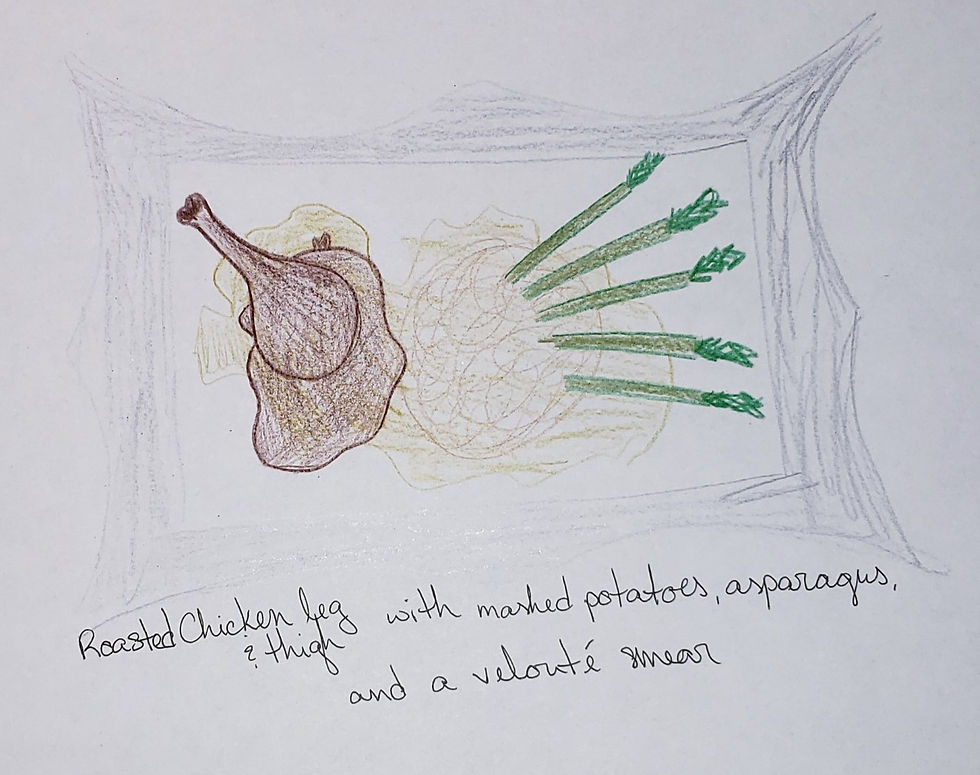
Plate Presentation:
Sources:


https://marleyspoon.com/menu/45615-apricot-mustard-chicken-with-asparagus-sour-cream-mashed-potatoes
Reflection & Summary of Results
Unfortunately for me, I was unable to participate in lab for this dish. I tested positive for COVID-19 and was required to quarantine for two weeks. One of my classmates was kind enough to share his blog with me, and this is what he had to say about preparing the dish in our cooking lab...
Week 5 Review
Roast Chicken, Steamed Asparagus, Garlic Mashed Potato, and Supreme Sauce Results Throughout our time in the lab I feel like we as a group did a great job. Everything ran smoothly, we worked good as a team, and the food turned out amazing. I was expecting this outcome because I was very familiarly with all the dishes techniques and procedures. Did the cooking technique work or not? For the most part the cooking techniques worked great, the instructions were clear and easy to follow. The greatest success I believe we had was putting the garlic butter underneath the chickens skin. We obtained a great covering of most the chicken which is what made the skin so crunchy and moist after cooking. Another technique that worked great was mashing the potatoes. I have never before used a potato ricer but man, that things is sweet. In the past I have used a potato masher which is awesome but that potato ricer is in a whole different league. The only technique I could think of that didn't work for us was with the supreme sauce. For some reason the supreme sauce was terrible. It had a graining texture which was due to our technique when putting the flour in, furthermore, we added too much. I wish I could go back and make a better supreme sauce but, we will save it for a rainy day. Texture Roasted Chicken The roasted chicken had a tremendous texture. The chicken was moist, soft, and crunchy. The meat of the chicken had a great balance between flaky and firm which was caused by the moistness of the chicken. Asparagus We sautéed and then steamed our asparagus which can it a nice outside crunch but with a soft middle. Garlic Mashed Potatoes Our potatoes were extremely soft and fluffy. When finished they looked like a cloud in the sky. They had a great median between too thick and too thin; we hit the goldy lock zone. Supreme Sauce The texture of our supreme sauce was terrible. It was gritting as could be, it almost tasted like someone put sand in it and the sauce was also too thick. It was just an all around disaster. Taste Roasted Chicken The taste of the chicken was wonderful. It had that iconic taste that contributed a delicate but wholesome feel when eaten. The juices from the chicken were salty but not too salty. My favorite taste with this dish was the garlic. The garlic gave off that pop you look for when using it. That strong aroma and taste was awesome. Asparagus For our asparagus we got creative. The union we added created a great sweet taste that complimented the dish very well. The mushrooms added that earthy, wholesome, and sweet taste. Once again that garlic produced a warm and spiciness taste. Of course, you can't forget about the asparagus. It added an earthly, cleansing, and that slight bitterness. Garlic Mashed Potatoes The potatoes added a filling, semi-sweet, and starchy taste. They really gave me that feeling of a great potato. The garlic added so much taste to the dish, like I previously said it produced a warm and spiciness taste. Supreme Sauce The only taste I will received from the supreme sauce was salt and the stock used. I believe this is so because we messed it up pretty good. But, to me I could only taste them. The chicken stock gave off that cleansing and chickening taste you would expect. The salt, of course added that savory, bitter, taste. Flavor Roasted Chicken The roasted chicken had a great flavor that was caused from a great conjunction of the chicken and garlic butter. The garlic butter gave the chicken skin that crunchy and juicing skin that produced an amazing savory flavor. This mixed with the moist and delicious meat created a one way trip to flavor town. Asparagus The asparagus, unions, garlic, and mushrooms created a flavor that was sweet, earthy, bitter, and spicy. But non of the taste over powered one another so they created a great mixture that I was super pleased with. Garlic Mashed Potatoes The garlic mashed potatoes were splendid. The starch from the potatoes and the garlic butte mixed beautifully. The potatoes battled the garlic to allow the garlic to not over power the dish. But, the the flavor of the garlic butter was still present. Supreme Sauce The flavor of this was terrible which I believe was our fault. The supreme sauce only flavor profile was salt and chicken stock but a thicker, grosser version. Appearance


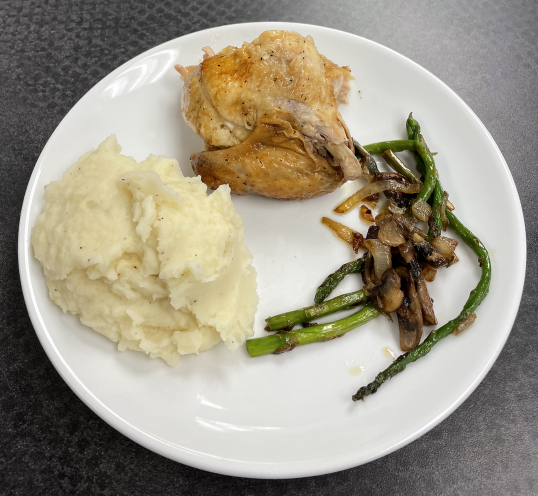
Evaluation Why did certain techniques work or not work? What Worked One technique that I found was very beneficial was the method of tying up the chicken prior to cooking. The way we tied up the chicken allowed for even cooking. I know this because when I was cooking I would check the temperature to see if it was finished. Most the times I checked, it wasn't finished but, every part of the chicken was 5 degree within each other. So, the technique I used was extremely beneficial. Another technique that worked great was sautéing the asparagus then finishing them off by steaming. This allowed the asparagus to have a firm outside with a slight char, and a soft moist inside. I liked this because only steaming asparagus doesn't give it that firm, charred outside. This was a superior upgrade. Another technique that worked great was utilizing the potato ricer for making the garlic mash potatoes. Using this tools created a much more uniform, soft, and fluffy mashed potato. Especially compared to prior times when I have used a potato masher.
What Didn't Work The worst failure we came across was when making our supreme sauce; it was terrible. When mixing the flour into our butter sauce to make our blonde roux we added too much and added the flour too rapidly. This caused the sauce to have a gritty texture and an awful flavor. This was so bad and so far has been the biggest failure in my cooking, I couldn't believe I produced something of such poor quality.

What could/would you do to improve the outcomes? There are only a couples way I would do to produce a better outcome. First, I would throw the supreme sauce I made and start over. Unlike this go around I will add the appropriate amount of flour and add in the flour less rapidly. Doing both of these things should make my supreme sauce actually taste good which would enhance the total dish. Secondly, I would turn the oven 25 degrees hotter. During the lab we had trouble getting the core of our chicken to the proper temperature. Although, we got it there eventually, it took way to long and held up lab time. So, by making the oven 25 degrees hotter I believe the chicken would have cooked more efficiently. As well, the chicken taking longer than expected messed up our garlic mashed potatoes. It did so because we planned on the chicken being done but it was delayed by twenty minutes so our mashed potatoes got cold which was a bummer. Conclusion Learning Objectives The learning objectives I achieved the best in our lab was "Apply the principles of boiling potato to make a mashed potato" and "Acquire and apply the basic principles and techniques of common dry-heat cooking methods." Our mashed potatoes cooked perfectly which made them amazing when they were hot but, they got cold 😤. When taking them out of the boiling water they were perfect; not to firm, not too soft. This is what made our garlic mashed potatoes so good. We used dry-heat cooking to cook our chicken which turned out awesome. The chicken had a moist inside and crunchy outside skin, I couldn't have asked for a better chicken. Except for it not taking as long too cook, but you can't rush perfection. Techniques Learned Outside of Objectives During the lab I learned what and how to use a potato ricer instead of a potato masher and the potato ricer is awesome. Prior to this lab I had no idea such thing existed but now that I do I will only use it. It was so much easier and effective, so now I will never look back. Another technique I learned so how to properly tie up a chicken for roasting. I have roasted chicken in the past but I have never tied it up like we did in the lab and this way was so much better. The chicken cooked nearly perfectly even which is exactly what you want. How I can Apply What I Learned As said before I will 100% utilize the potato ricer and method of tying a roasted chicken but, the biggest thing I learned is what not to do when making a supreme sauce. I learned that adding too much flour and adding it too rapidly makes a sauce almost inedible. So, in the future I will add less flour and add the flour in slowly so I can watch the transformation more closely. A great message I will take from this is: You can't take anything out but you can add things in. What Needs More Practice What needs more practice is obviously making supreme sauce. Furthermore, I need to practice making a better roux. That was the root of my problem when creating supreme sauce. But, with anything practice makes perfect, so in the future I will know not to add too much flour and to add flour at a slower rate. Citations Harlan, J. (n.d.). Make smooth and creamy mashed potatoes with a potato ricer. Retrieved September 20, 2021, from https://www.thespruceeats.com/how-to-use-a-potato-ricer-909008 Margaret Eby Updated February 07, Eby, M., Eby, M., & 07, U. (n.d.). What's going wrong with your roux. Retrieved September 20, 2021, from https://www.myrecipes.com/how-to/roux-mistakes Sauce supreme. (n.d.). Retrieved September 20, 2021, from https://www.emerils.com/120138/sauce-supreme Labensky, S. R., Martel, P. A., & Hause, A. M. (224). On Cooking: A Textbook of Culinary Fundamentals, 6/e. Retrieved from https://platform.virdocs.com/r/s/0/doc/395669/sp/17707992/mi/59019648?cfi=%2F4%2F2%5BP7001015078000000000000000003545%5D%2F14%5BP7001015078000000000000000003611%5D%2F18%5BP70010150780000000000000000036A7%5D%2F8%5BP70010150780000000000000000036B1%5D%2F4 Labensky, S. R., Martel, P. A., & Hause, A. M. (429). On Cooking: A Textbook of Culinary Fundamentals, 6/e. Retrieved from https://platform.virdocs.com/r/s/0/doc/395669/sp/17707992/mi/59019648?cfi=%2F4%2F2%5BP7001015078000000000000000003545%5D%2F14%5BP7001015078000000000000000003611%5D%2F18%5BP70010150780000000000000000036A7%5D%2F8%5BP70010150780000000000000000036B1%5D%2F4
If you would like to see his full blog, you can find it here...
https://dcm0062.wixsite.com/my-site/blog
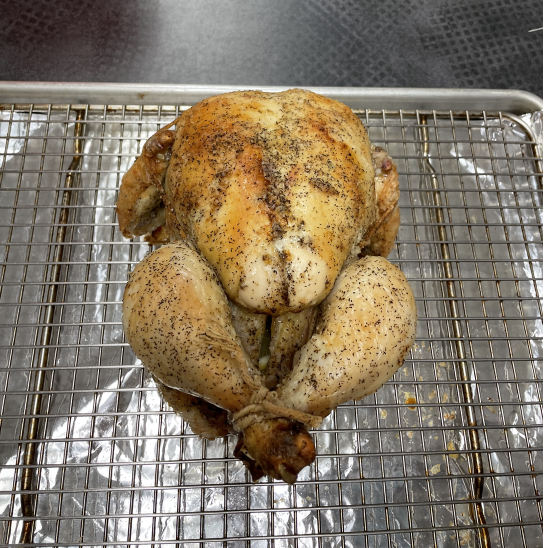
I am so grateful to my team for helping me stay caught up during this time away from lab. I managed to find the energy to roast a chicken at home. The color was GORGEOUS!!! I couldn't taste or smell it...stupid covid 😊 ... but my family said it was yummy. Take a look and decide if you'd be willing to give it a try.


Comments