Week 3: Irish Sausage, Breakfast Sausage, & Seafood Sausage
- kelafoy
- Aug 31, 2021
- 8 min read
Updated: Sep 3, 2021
Introduction
This week we are continuing our study of Garde Manger with a focus on Charcuterie & Sausage.
Method of Cookery:
Charcuterie… “So what is this mysterious “charcuterie”? Pronounced shahr-kyut-uh-ree it is a French word that comes from chair “flesh” and cuit “cooked.” It refers to cooked, cured or smoked meats such as bacon, ham, sausage, terrines, rillettes, galantines, pâtés and dry-cured sausage. Charcuterie has been considered a French culinary art since at least the 15th century. The specialized store in France is also called a charcuterie and will have confits, foie gras and a selection of ready-to-eat dishes.” (D’Artagnan, 2014)
Sausages… “In form, sausages may be patties of freshly chopped and seasoned meat or they may be stuffed in casings, dried, fermented, smoked, or produced using any combination of these techniques. The meats can be ground exceedingly fine (weisswurst) or simply cut into large chunks (headcheese). Some are eaten cooked, using any of the traditional methods for cooking meats, while some are so heavily cured and smoked that they can safely be eaten raw (salame crudo).” (Sausage House, 2016)

(Weisswurst)
Prior Knowledge of the Dish: Let me start by saying that I LOVE CHARCUTERIE BOARDS! I could eat them for every meal, every day, for the rest of my life. 😊 The rich, salty meats, the creamy cheeses, and sweet yet acidic jams make my mouth water just thinking about them. That’s all I’ve ever really known about them though. I graduated high school with a wonderful person who specializes in charcuterie. You should totally go check out #thegrazerco if you ever get the chance. Her food art is not only beautiful, but delicious.
My experience with sausage extends about as far as my experience with charcuterie. I love to eat all kinds of sausages, but I have never made any. I grew up with a Prussian grandmother. I was taught by my Omi to appreciate the various flavors of all types of meats and sausages. I must say that my favorites are Knockwurst, Bratwurst, and Braunschweiger (more of a Pâté than a sausage).
Learning Objectives:
Understand the role of sausages in culinary history
Identify necessary ingredients for sausages
Explain the importance of proper equipment selection, care and use in making sausages
Classify various types of sausage
Discuss fermented sausages and their manufacture
Describe the process of making basic grind sausages
Contrast the basic process with the procedure for emulsion sausages
Recognize the value of testing
Distinguish suitable garnishes for sausages
Clarify the various types of sausage shaping options and preparation methods for each type
Background Information
Origin & History:
Charcuterie… “Like many traditional foods that are making a comeback, charcuterie is a culinary art developed from necessity; it is the way meats were preserved long before the days of refrigeration. And just like pickles, fermented vegetables, home drafted beer, broth and kombucha, charcuterie has been revived and brought front and center by the traditional food movement.” (Spiker, 2014)
Sausage… “Sausages were probably first invented as a means of preserving blood, offal, and small scraps of meat in convenient edible containers—the stomachs and intestines of the slaughtered animal. The earliest known reference to sausage dates to Greece in the eighth or ninth century B.C.E.” (Sausage House, 2016)

Methods Used:
Charcuterie… “Germans sell their cured meats at a delicatessen, and Italians purvey salumi in a salumeria. In America many of the Italian salumi products are familiar, such as prosciutto, salami, pepperoni, sopressata and mortadella. If you’ve ever eaten antipasto you already know about charcuterie. Been to the deli and ordered a liverwurst sandwich? How about a cold cut sandwich? Both are charcuterie. Even baloney is charcuterie. Spain is legendary for dry-aged aging hams from heritage breed pigs. Germany is noted for the frankfurter and Braunschweiger, among a myriad of sausages produced there. Poland offers the smoked kielbasa. And in the United States there are many that swear by the flavor of smoked and cured Virginia ham.” (D’Artagnan, 2014)
Sausages… “Chipolata – Sometimes also called “little fingers,” these tiny (2- to 3-inch-long), coarse-textured pork sausages are highly spiced with thyme, chives, coriander, cloves and sometimes hot red-pepper flakes. The French term à la chipolata refers to a garnish of chipolata, chestnuts and glazed vegetables used to accompany roasts.
Italian Sausage – It is a style of pork sausage which is noted for its seasoning of fennel and/or anise, containing at least 85% meat. Italian Sausage is made in sweet and hot styles. It is generally not cured, and is normally grilled and eaten with giardiniera or other vegetables. A less widely available variety of kielbasa, the White Fresh (biała), which is sold uncooked and unsmoked, then usually boiled or cooked is said to taste similar to Italian sausage.
Liverwurst – A broad term for “liver sausage” referring to well-seasoned, ready-to-eat sausage made from at least 30 percent pork liver mixed with pork or other meat. The texture of liverwurst can range from firm enough to slice to creamy-smooth and spreadable. Liverwurst (the most popular of which is braunschweiger) can be smoked or plain and comes in large links, loaves and slices. It’s typically served for snacks and sandwiches and is especially suited to rye breads.
Mortadella – A smoked Italian sausage made of ground pork and beef and cubes of pork fat, flavored with wine and spices.
Haggis – It is the Scottish national dish. Haggis is nothing more than a large sausage made of seasoned sheep organ meats and oats, stuffed in the sheep’s stomach.” (Sausage House, 2016)
Dish Variations: “Whenever it was that humans started to cook and cure meat, it has not stopped since. Sausage recipes date to before the golden age of ancient Greece, and traditional sausages have been made for over 2000 years in both Rome and France. The Romans set standards for raising, killing and cooking pigs, and they regulated the process. Centuries ago, Germanic tribesmen made fortunes selling salted hams made from acorn-fattened boars that were hunted in dense forests. But charcuterie really comes into its own in France during the Middle Ages.” (D’Artagnan, 2014)
References
“Charcuterie 101.” Center-of-the-plate.com. D'Artagnan. https://center-of-the-plate.com/2014/09/03/charcuterie-101/. 3 September 2014.
“History of Sausages.” Sausagehouse.in. http://sausagehouse.in/history-of-sausages/. 2016.
“What The Heck Is Charcuterie? And Why you Need It At your Next Party!” theorganickitchen.org. Linda Spiker. https://www.theorganickitchen.org/what-the-heck-is-charcuterie-and-why-you-need-it-at-your-next-party/. 15 December 2014.
Dish Production Components
Recipes:


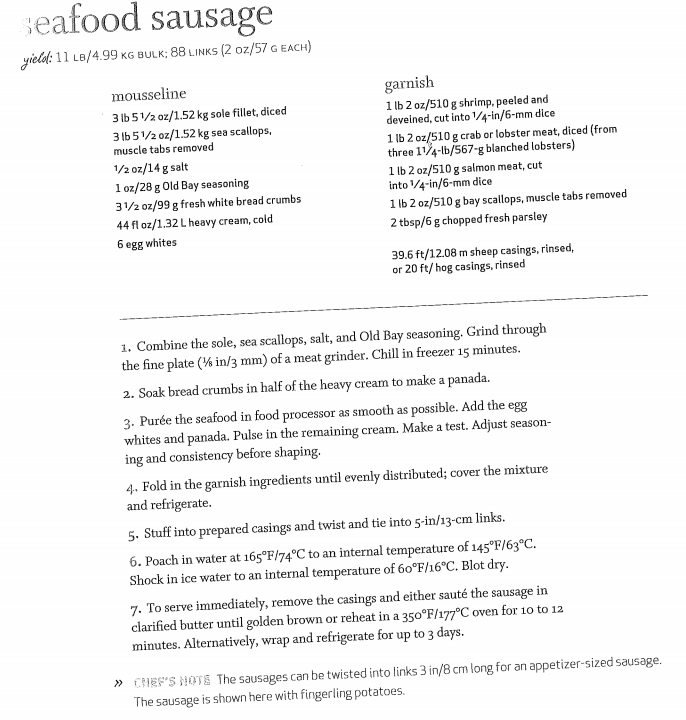
Plan of Work:

I may not have enough lab time to complete everything in my plan this week within the 4 hours allotted to us. Fingers crossed I can manage my time better than I have it set out in my Plan of Work. 😉
Plate Presentation:
For my presentation ideas I tried my hand at designing a charcuterie board using the prepared sausages we are making this week, as well as a plated meal using the Irish sausage. For both designs I chose accoutrements that I think will contrast, yet pair very well with the intense flavor created by the meats.

Sources:
Charcuterie...


Sausage...


Reflection & Summary of Results
What Happened(?): This week was somewhat of a comedy of errors. There was no pork bought for us to make our Irish sausage or our breakfast sausage. We also did not have any seafood delivered to make our seafood sausage. However, we did what the culinary world does best, and we made it work. Thankfully one of our amazing instructors / chefs was able to get pork delivered to put together the Irish sausage after all. The seafood sausage was replaced with Carne Fria (Shout out to Chef Ana!), a commonplace sausage among the Latin community made with beef, pork, and ham ground together; then our seasonings, olives, roasted red peppers, eggs and cracker meal combined into it. The Carne Fria is hand rolled in foil then poached in a pressure cooker for about 15 minutes after optimal pressure is reached.



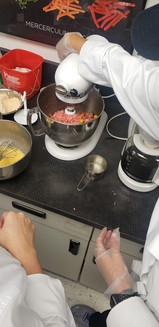

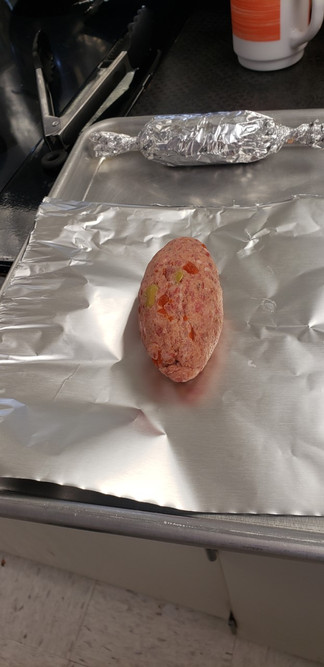


It had a very familiar taste to it, almost like a fine bologna or meat pâté. Take a gander at the finished Carne Fria below! The lovely addition on the plate is fried pork skin, also known as Chicharrons. What a pleasant crispy bite that melts into that creamy fattiness we all love to feel glide across our tongues. Now hold on tight, because creamy seems to be the texture of the week. 😊 (I know, it surprised me too.)

Evaluation: Preparing and stuffing the Irish sausage was entertaining for me. There is something soothing about watching the meat go in whole and come out soft and pliable. It’s almost like adult play-doh. 😊 To flavor the sausage, we sweated just under a pound (420g) of diced onion to add to the ground pork and ran it through the meat grinder a second time. Along with the onions, we added breadcrumbs, salt, pepper, thyme, sage, and a little water…well…a lot of water. It takes about 3 liters of water to create 13 pounds of sausage. After spending a few minutes in the industrial sized electric mixer, the sausage mixture gets pureed into a smooth creamy texture in the food processor.


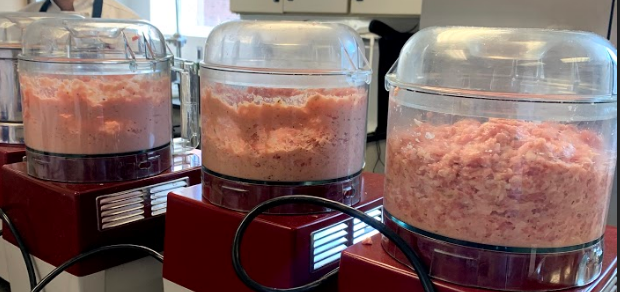
Once the sausage mixture was ready, it was set aside to chill while the casings for the sausage were prepared for stuffing. Soaking them in water helps to remove some of the salt preservative and make them less sticky. Casings are ornery little devils and like to be temperamental with you if you don’t have the right amount of finesse. Getting them to separate at one end to place on the nozzle of the electric sausage stuffer proved to be a challenge. Add to that the unfortunate habit of the meat mixture to explode through the casing from time to time due to air bubbles, and you’ve got one heck of a messy project.


Our Irish sausage wasn’t complete in the amount of time we had in lab. A few students were able to stay behind to continue twisting the sausage into links and pricking the sausage. It is my understanding this is done to allow the release of water during the cooking process to prevent boiling hot water from exploding through the casing and possibly injuring someone. It can aid in the release of water during the preservation process as well.
Some people are against pricking. It is said to release not just water, but fat from the sausages. Losing fat means losing flavor. “There is a theory that pricking a sausage lets the fat out, making them healthier. That's like wanting to visit the Berlin Wall but being afraid of Germans. Sausages are, by definition, fatty. By Australian law they can be up to 50 per cent fat. But fat is the flavour, and if you want to avoid fat you should avoid sausages. Low-fat sausages are about as pointless as dehydrated water. Cook sausages slowly over low heat on a greased grill, turning several times. High heat will simply cause them to split their skins and expunge their precious bodily fluids.” (Cornish, 2014) Hopefully pricking did not ruin the results we are trying to achieve.





On a wonderfully bright note, the Gravlax from Week 2 turned out beautifully. 😊 The salmon melted in your mouth like creamy butter spread on a piece of warm sourdough bread. The dill gave it a nice coolness with each bite, making it feel like a great summertime treat.


I tried some gravlax with a cream cheese spread flavored with capers and lemon zest on a thin slice of pumpernickel bread. The almost bitter flavor of the bread was offset by the bright citrus notes in the cheese spread. The saltiness of the capers brought out the richness and the creamy feel of the salmon.

The gravlax was presented multiple ways by the students, and they are all visually appealing. Each dish was delicious and gave variety to the smooth texture of the salmon. We found that we definitely needed a vehicle to eat the salmon with. Eating it alone had the feel of cake icing but the flavor didn't match the mouth feel. Adding texture to the bite made it more pleasing.







Conclusions: Sausage ingredients, the bowls you use, and the tools needed to create the end-product all must be ICE COLD. If your mixture isn’t cold enough everything turns to mush, and the meat product is much harder to manipulate. “In order to grind the meat cleanly, all the grinding equipment must be kept exceptionally cold—but not frozen, which could cause the meat to stick.” (Sevier, 2017) Using metal bowls is also recommended because they cool better / faster. My biggest takeaway from this experience is this…HOW ON EARTH DID OUR ANCESTORS DO IT? Making sausage is an undertaking with modern tools and technology at our disposal. Human beings have been making and preserving sausages for THOUSANDS of years. Yes, I said thousands all big like that on purpose…you know…for effect. 😉 I hope you enjoyed this week as much as I did. I can’t wait to see where this journey takes us.
References
“Everything You Need to Make Sausage at Home.” Epicurious.com. Joe Sevier. https://www.epicurious.com/ingredients/everything-you-need-to-make-sausage-at-home-article. 26 October 2017.
“The sausage dilemma: To prick or not to prick.” Goodfood.com.au. Richard Cornish. https://www.goodfood.com.au/recipes/the-sausage-dilemma-to-prick-or-not-to-prick-20140120-313qp. 21 January 2014.


Comments