Week 3: French Bread, Rustic Sourdough Bread, & Pumpernickel Bread
- kelafoy
- Jan 26, 2022
- 8 min read
Updated: Jan 29, 2022
Introduction
Week 3 of Patisserie & Confectionary concentrates on Lean Yeast Dough. Our focus will be sponges, preferment (also known as poolish), and sourdough breads.
Method of Cookery:
“What is a preferment? A preferment is a mixture of flour, water, leavening (commercial yeast or sourdough starter), and time — a key ingredient! As the mixture ferments over the course of 12 to 16 hours, the delicious by-products of that fermentation build up and infuse the starter, the dough, and the finished loaf.” (Philip, 2020)
“A ferment is easy to make and usually consists of a simple mixture of wheat flour, water, and a leavening agent (typically yeast). Two schools of thought exist regarding the inclusion of salt or sugar. They both act to inhibit or slow yeast growth, as determined by time to proof or rise, so they are not usually included and instead are added to the final dough. Ultimately, the amounts of each ingredient, and when they are added, depend on pre-ferment and final-dough formulas.” (Wikipedia, 2022)
Prior Knowledge of the Dish:
I know little to nothing about preferments. I have always wanted to create my own sourdough, but I have never had a sourdough starter and I was unsure of how to make one. I’m excited to put it to the test this week and see what happens. Chef Ana is preparing the starters for the sourdough and pumpernickel breads the day before lab. This will allow us to have something to work with. I think I am least looking forward to the French Bread Sponge. I feel fairly confident with the straight dough method since my limited experience with breads and doughs has always incorporated this method. I tend to get a little more jazzed about trying new things. 😊
Learning Objectives:
· Explain the methods for preparing sponge doughs and prepare sponge doughs and yeast pre-ferments.
· Prepare and maintain sourdough starters and use them to mix doughs.
· Ferment and bake sponge dough and sourdough products.
Background Information
Origin & History:
“This breadmaking method was first developed in Poland during the 1840s by a nobleman named Baron Zang. Poolish was later spread by Viennese bakers into Austria who upon emigrating to France around 1840 initiated the production of Vienna breads and other luxury bakery products in Paris using the Poolish technique. With this technique bakers switched from using associations of yeast and sourdough (sur levain in French) to yeast alone for carrying out fermentation at the bakeshop.” (Baker Pedia, 2020)
“The term “poolish” comes from the old English “polish”. It is quite famous in French bread-making. It’s mostly always 100% hydration…. This type of leavening process comes from Poland. Its first mention goes back in 1840. It was brought by bakers to France in the 1920’s.” (Vincent, 2020)
Methods Used:
“Poolish: This is a classic of French bread-making. It's used a lot in home-baking when people don't want to keep a sourdough starter. It gives a crumb similar to a starter-based bread, and a crust similar to a yeast-based bread.” (Vincent, 2020)
“A Poolish resembles a sponge for the sponge and dough system. The difference is Poolish is fermented much longer and uses a much higher hydration than a plastic sponge—which is why it’s considered the liquid version of a sponge. Typical hydration levels are 100%, with equal weights of flour and water.” (Baker Pedia, 2020)
Dish Variations:
“The preferment family is a group of oddballs. Some are active and will blow the lid off a container, while others prefer to take it easy. Whole grain flour is all the rage in some cases, but cross an international border and bakers might swear by all-purpose flour instead. Regardless of which flours you use or what name you give it, preferments generally fit into one of four categories.” (Philip, 2020)
“In general, there are two ferment varieties: sponges, based on baker's yeast, and the starters of sourdough, based on wild yeasts and lactic acid bacteria. There are several kinds of pre-ferment commonly named and used in bread baking. They all fall on a varying process and time spectrum, from a mature mother dough of many generations of age to a first-generation sponge based on a fresh batch of baker's yeast:
Biga and poolish (or pouliche) are terms used in Italian and French baking, respectively, for sponges made with domestic baker's yeast. Poolish is a fairly wet sponge (typically one-to-one, this is made with a one-part-flour-to-one-part-water ratio by weight), and it is called biga liquida, whereas the "normal" biga is usually drier. Bigas can be held longer at their peak than wetter sponges, while a poolish is one known technique to increase a dough's extensibility.
Sourdough starter is likely the oldest, being reliant on organisms present in the grain and local environment. In general, these starters have fairly complex microbiological makeups, the most notable including wild yeasts, lactobacillus, and acetobacteria in symbiotic relationship referred to as a SCOBY. They are often maintained over long periods of time. For example, the Boudin Bakery in San Francisco has used the same starter dough for over 150 years. A roughly synonymous term in French baking is levain.
Mother dough often refers to a sourdough, and in this context the term starter often refers to all or a piece of mother dough; however, mother dough may also refer to a first-generation yeast sponge; so the process used in relation to the ingredients and fermentation times is important to understanding yeast versus sourdough methods. A roughly synonymous term used in French baking is Chef.
Old dough (pâte fermentée) may be made with yeast or sourdough cultures, and in essence consists of a piece of dough reserved from a previous batch, with more flour and water added to feed the remaining flora. Because this is a piece of old dough, it has the typical ingredient of salt to distinguish it from other pre-ferments. Once old dough had rested for an additional 10 hours of age, the French named it Levain de Chef.” (Wikipedia, 2022)
“You may have heard names like sourdough starter, biga, poolish, levain, pâte fermentée, or even desem. All of these are preferments.” (Philip, 2020)
References
“Baking with preferments.” Martin Philip. https://www.kingarthurbaking.com/blog/2020/02/05/baking-with-preferments#:~:text=What%20is%20a%20preferment%3F,dough%2C%20and%20the%20finished%20loaf. 5 February 2020.
“POOLISH.” Vincent. Baking History. https://baking-history.com/poolish/. 25 May 2020.
“Poolish. Also known as Pâte fermentée, liquid pre-ferment or liquid sponge.” Baker Pedia. https://bakerpedia.com/processes/poolish/. 2020.
“Pre-ferment.” Wikipedia. https://en.wikipedia.org/wiki/Pre-ferment. 2022.
Dish Production Components
Recipes:
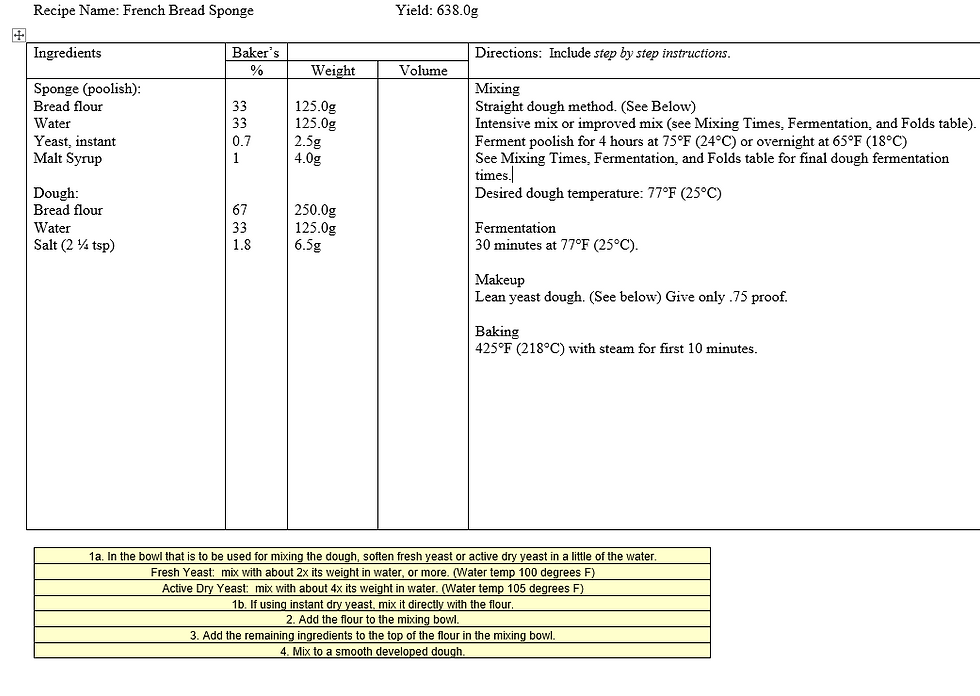
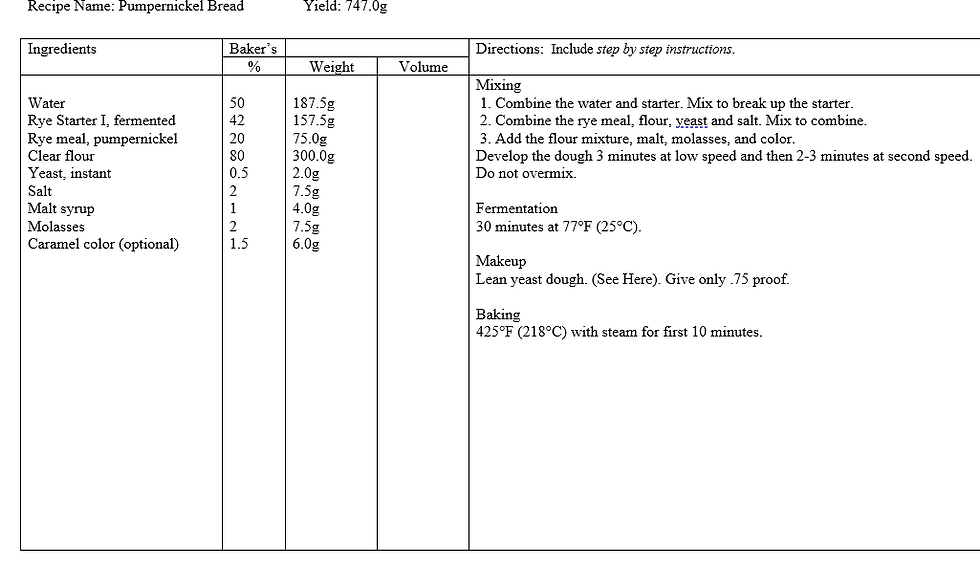

Plan of Work:
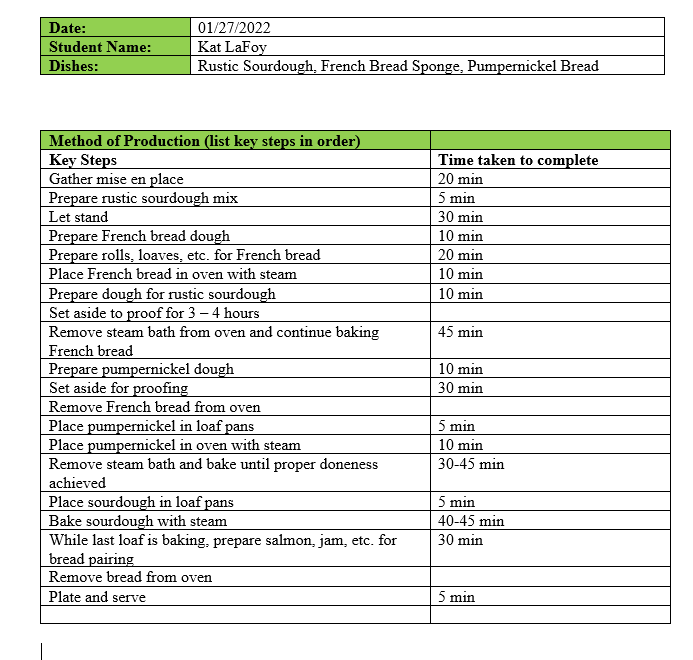
Plate Presentation:

Sources:


Reflection & Summary of Results
What Happened(?): Whew let me tell you! This week was a bit of a kerfuffle. 😉 The Rustic Sourdough needed A LOT longer to proof than we could give it. We also added our salt to our starter late to hinder the fermentation. I'm now thinking that may not have been a wise idea. To make matters worse, I got my production order a little mixed up and placed it in the oven about an hour and a half earlier than I intended AND didn't use any steam when cooking it. It was a mess.
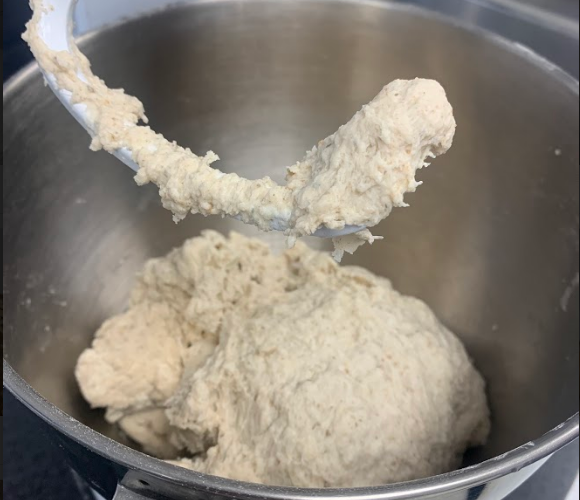
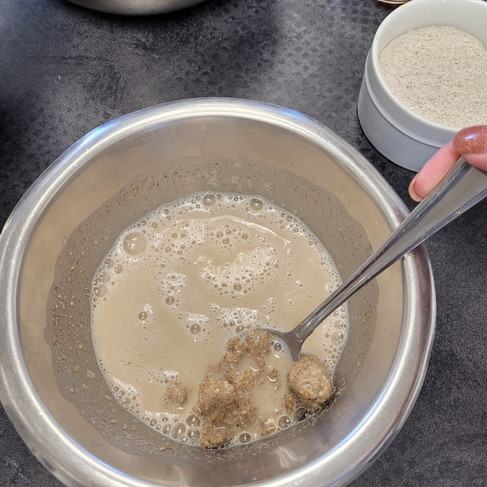
The pumpernickel didn’t rise at all. We had an oven set on very low heat, which was turned off before use, to be used as a proofing drawer. My team’s pumpernickel was the last to go in and the oven had gotten too cold. We tried to save the dough by placing it on a warm stovetop…BUT ALAS ☹ …it was not successful. I thought it was really neat to watch the slurry slowly develop as we rehydrated the rye starter though. The techniques and science behind the beautiful creations in the culinary world fascinate me.
“Just like baking, proofing is a thermal unit operation in the bakery. During proofing, the dough absorbs heat from the humid, warm surroundings to reach a target internal temperature. The final proof accomplishes two major goals:
1. It allows more carbon dioxide to be produced through fermentation. This causes the gluten to become extensible again. After sheeting and moulding, the dough lacks extensibility and is mostly degassed with larger air cells subdivided. Proofing rectifies these “problematic” conditions in the dough.
2. Biochemical leavening produces the desired volume, cell structure, flavor, and eating qualities of the finished product.” (Pearce, 2022)




Our end goal with the French Bread Sponge was to make split rolls. We found the perfect size tool to create a crease in the center of each roll. The dough was being really ornery though, so the creases would pop right back out. I think it was a little angry with us for manhandling it while we were practicing the rolling technique. The gluten had become too tight and wouldn’t allow the dough to be shaped any further.
“The overworked dough will often feel tight and tough. This means that liquid molecules have been damaged and won't stretch properly, causing the bread to break and tear more easily. Conversely, a dough that is underworked will be harder to form into a ball shape. The underdeveloped gluten molecules will cause your dough to flop around and tear easily. While underworked dough can simply be fixed by a little more kneading, severely overworked dough cannot be fixed. Instead, the overworked dough will result in a hard loaf that will likely not be eaten. It's important not to overwork your dough and continually check for overworking throughout the kneading process.” (Bob’s Red Mill, 2020)







Food Cost:


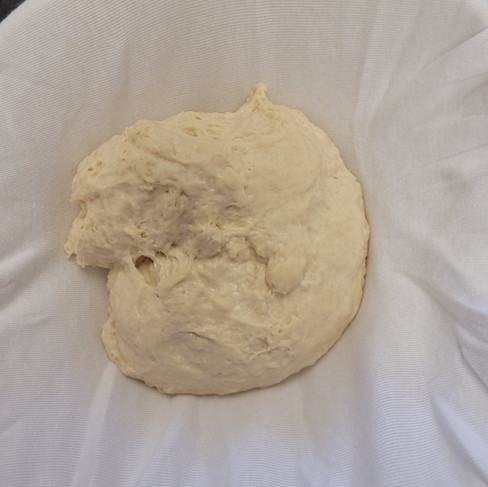
Evaluation: Let’s talk about sourdough. Oh boy the sourdough! The thing we needed most was time. Not only did we not have enough of it, but mistakenly denied ourselves much of what we did have. Initially, it just would not bake through. It was very dense and doughy with a crust that appeared to be almost gray. It was not very appetizing to look at.
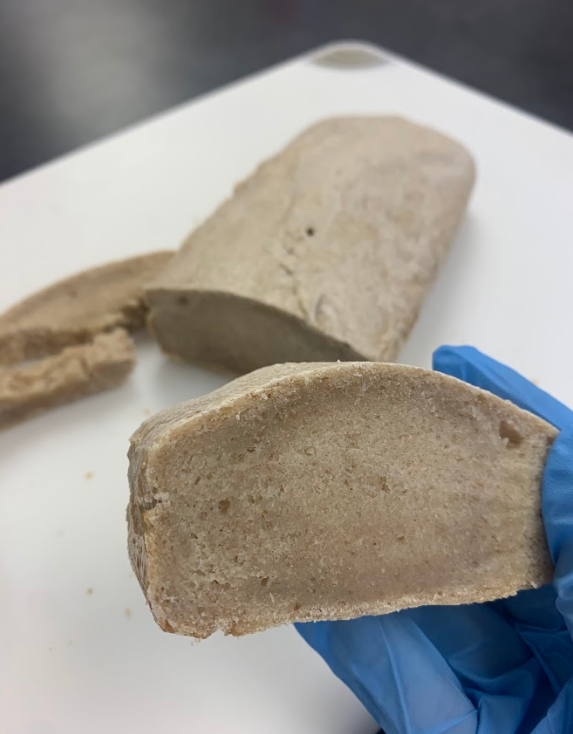
We placed it back into the oven for about 25 more minutes. The inside reached the desired temperature of 210̊ F, but it still had a slightly underdone texture to it and the crust was hard as stone.



Since our pumpernickel dough didn’t proof at all, the dough developed a crust before we ever placed it in the oven. We marked a deep X shaped score in our dough, attempting to create something similar to this…

…but since it didn’t proof properly it turned out all wonky like this…

It had very few air bubbles which are usually formed during proofing, so it didn’t get the balanced rise when baking that it normally would. The taste was okay. It was a little bland, but again that comes from lack of proofing and possibly from us using dark rye flour in place of rye meal.
As for the French Bread Sponge…it turned out FABULOUSLY! 😊




Chef’s Graduate Teaching Assistant, Shenee, helped my lab partner and I learn how to manipulate the dough to create rolls. I must say, that is much harder than it looks. AP did an awesome job. I still need a good bit of practice.

Conclusions: I had my plan of work with me, and the day started out marvelously. I got caught up in too many similar tasks though and didn’t reference my plan. In the future I think I’ll make a more concerted effort to mark things off as I go along to force myself to continuously verify that I am not only on task, but on the correct task. Another note to self…ALWAYS check the temperature of your proofing drawer before placing dough inside to rise.😊 This lab was a unique learning experience for me. I love to bake, but bread is a whole new world for me. I can't wait to see what the rest of the semester holds!

References
“Can You Over-Knead Bread?” Bob’s Red Mill. https://www.bobsredmill.com/blog/healthy-living/can-you-over-knead-bread/#:~:text=Overworking%20or%20over%2Dkneading%20dough,it's%20easy%20to%20overdo%20it.&text=Conversely%2C%20a%20dough%20that%20is,flop%20around%20and%20tear%20easily. 8 September 2020.
“Final Proofing: A Key Thermal Step.” Ray Pearce. https://bakerpedia.com/final-proofing-a-key-thermal-step/. 2022.


Comments