Week 10: High-Fat or Shortened Cakes & Egg-Foam Cakes
- kelafoy
- Mar 15, 2022
- 6 min read
Updated: Mar 20, 2022
Introduction
CAKES!!!!! Now THIS is something I can get into! Cakes are my jam, and totally something I do ALL…THE…TIME. Let’s go take a look at how it all goes down. 😊
Method of Cookery: “There are several different ways of making a cake, and the method is determined by the fat you are using, and the end result you want to achieve...
CREAMING: This is the term used when a cake is made with butter or block margarine (soft or whipped margarines are unsuitable). It means that the fat and sugar are beaten together until creamy and pale: the eggs are then beaten into this mixture bit by bit.
RUBBING-IN: A cake made by this method starts off with the fat being rubbed into the flour – exactly the same as for short crust pastry. Butter, block margarine and lard can all be used. It is a very easy method.
BOIL-AND-BAKE: In recipes of this kind the fat and liquid are boiled together before the flour is added. Again, a very straightforward method.
ALL-IN-ONE: Exactly as the name suggests, these cakes are mixed all in one go. All the ingredients go into the bowl together and the mixing is done in seconds. Soft margarine is tailor-made for this method.” (Delia, 2022)
Prior Knowledge of the Dish: Just tell me what you want to know about a cake, and I’ve got you! I own and operate a home-based baking business under The Alabama Cottage Food Law.

If you want to check me out, you can do it here
or here
I LOVE to bake! I really get into the special request cakes that not everyone makes. Last summer I made a strawberry, key-lime, cheesecake, Bundt cake. The cheesecake was piped through the center of the cake before baking. It was OOOOOOOO so good!

I really enjoy the unique aspect of what you can do with cakes. The slightest alteration in a recipe can give you a completely different cake structure or flavor profile. It’s like doing daily science experiments you can eat afterward. 😊



Learning Objectives:
· Explain the three main goals of mixing cake batters.
· Mix high-fat or shortened cakes.
· Mix egg-foam cakes.
· Explain ingredient functions and the concepts behind formula balance.
· Scale, pan, and bake cakes correctly.
· Explain how to judge the quality of baked cakes and correct cake defects in them.
· Adjust formulas for baking at high altitudes.
Background Information
Origin & History: “The history of cake dates back to ancient times. The first cakes were very different from what we eat today. They were more bread-like and sweetened with honey. Nuts and dried fruits were often added. According to the food historians, the ancient Egyptians were the first culture to show evidence of advanced baking skills. The Oxford English Dictionary traces the English word cake back to the 13th century. It is a derivation of 'kaka', an Old Norse word. Medieval European bakers often made fruitcakes and gingerbread. These foods could last for many months.
According to the food historians, the precursors of modern cakes (round ones with icing) were first baked in Europe sometime in the mid-17th century. This is due to primarily to advances in technology (more reliable ovens, manufacture/availability of food molds) and ingredient availability (refined sugar). At that time cake hoops--round molds for shaping cakes that were placed on flat baking trays--were popular. They could be made of metal, wood or paper. Some were adjustable. Cake pans were sometimes used. The first icing were usually a boiled composition of the finest available sugar, egg whites and [sometimes] flavorings. This icing was poured on the cake. The cake was then returned to the oven for a while. When removed the icing cooled quickly to form a hard, glossy [ice-like] covering. Many cakes made at this time still contained dried fruits (raisins, currants, citrons).
It was not until the middle of the 19th century that cake as we know it today (made with extra refined white flour and baking powder instead of yeast) arrived on the scene. A brief history of baking powder. The Cassell's New Universal Cookery Book [London, 1894] contains a recipe for layer cake, American (p. 1031). Butter-cream frostings (using butter, cream, confectioners [powdered] sugar and flavorings) began replacing traditional boiled icings in first few decades 20th century. In France, Antonin Careme [1784-1833] is considered THE premier historic chef of the modern pastry/cake world. You will find references to him in French culinary history books.” (Olver, 2015)
Methods Used: “We start with perhaps the most technically accomplished of the methods known as the creaming method. With this method the butter and sugar are beaten together using plenty of elbow grease until the mix turns pale and creamy. At this point the eggs can be added, bit by bit, followed by the dry ingredients. The tricky bit is to avoid the mixture curdling once the eggs are added, which can split the mixture resulting in a less than appetizing tough or dry bake.” (Garrad-Cole, 2018)
“The two-stage method of cake mixing combines all the dry ingredients, including sugar, in a bowl. Then you add all the fat along with the wet ingredients (eggs, milk, flavorings) in two stages:
The first stage coats the dry ingredients with fat and allows you to develop some structure before adding the additional liquid.
The second stage adds in the rest of the liquid so the cake will rise evenly and be light.” (Field, 2013)
Dish Variations: “There are many different types of cakes and many different ways of dividing them into various categories, but professional bakers categorize cakes by ingredients and mixing method. (Home bakers tend to categorize cakes by flavoring—i.e., chocolate cakes, fruit cakes, and so on—which is helpful when you're trying to decide what to eat, but not as helpful when you're trying to understand how best to make a cake.) Depending on how the batter is prepared, you will find that the final texture (and color, if it is a yellow or white cake) varies.” (Worley and Malgieri, 2018)
References
“11 Types of Cakes to Satisfy Your Sweet Tooth.” Sam Worley and Nick Malgieri. https://www.epicurious.com/expert-advice/types-of-cake-glossary-article. 16 May 2018.
“Food Timeline FAQs: cakes.” Lynne Olver. https://www.foodtimeline.org/foodcakes.html#:~:text=According%20to%20the%20food%20historians,often%20made%20fruitcakes%20and%20gingerbread. 23 January 2015.
“Making Cake: 5 Techniques to Learn.” Holly Garrad-Cole. https://www.finedininglovers.com/article/methods-for-cake-making-success#:~:text=We%20start%20with%20perhaps%20the,followed%20by%20the%20dry%20ingredients. 23 February 2018.
“METHODS OF CAKE-MAKING.” Delia Online. https://www.deliaonline.com/how-to-cook/baking/methods-of-cake-making. 2022.
“The Two Stage Mixing Method | What It Is and How to Do It.” Jenni Field. https://pastrychefonline.com/the-two-stage-mixing-method/#:~:text=The%20first%20stage%20coats%20the,rise%20evenly%20and%20be%20light. 2013.
Dish Production Components
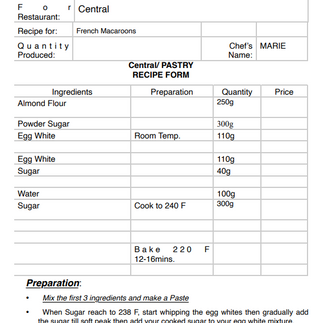
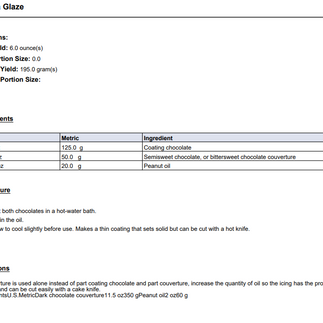
Recipes:







Plan of Work:
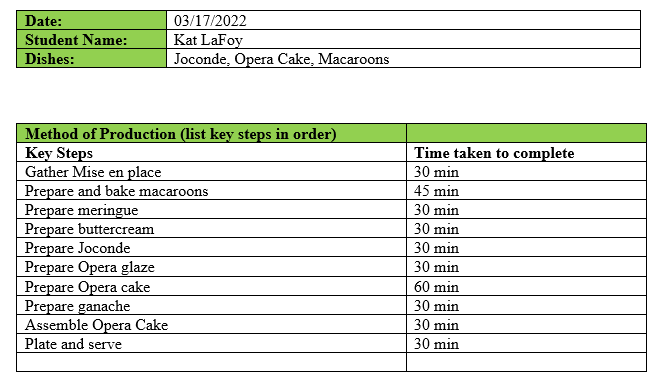
Plate Presentation:

Sources:


Reflection & Summary of Results
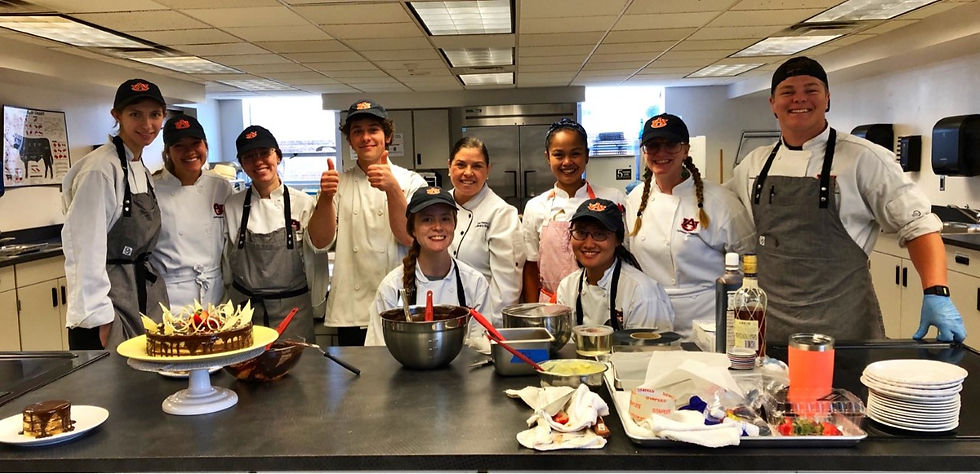
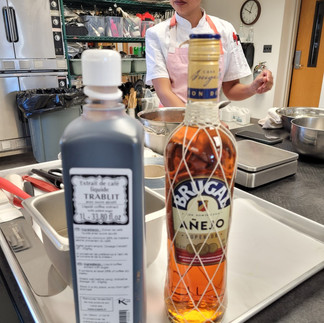
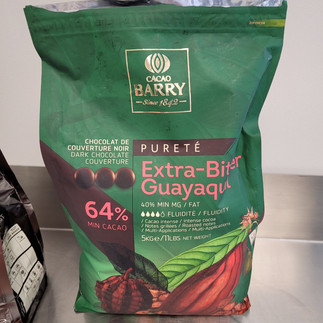
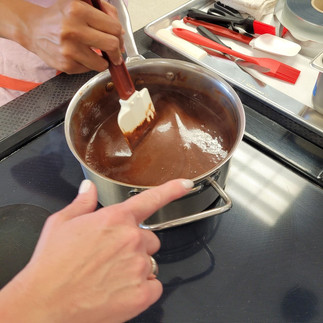
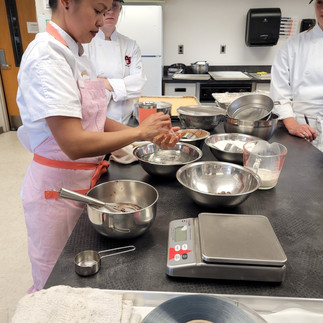
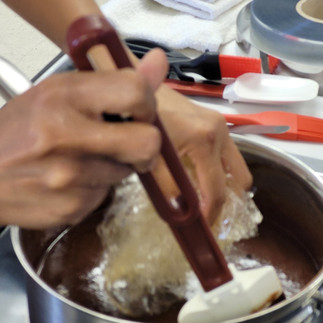
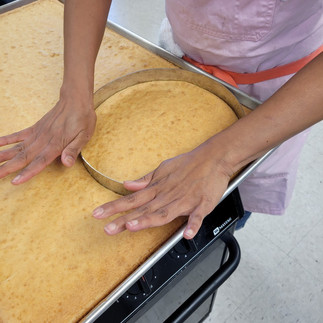
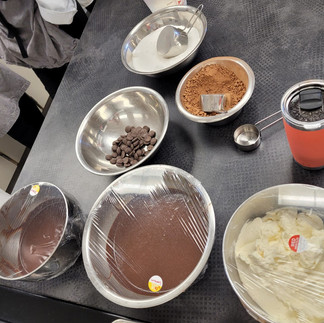
What Happened(?): Most of our lab this week was spent learning from a very special guest, Mrs. Marie McGarry from Central. “Central is an upscale casual restaurant and event venue, located in the heart of Montgomery’s Downtown entertainment district. Central is proud to be the #1 rated restaurant in Montgomery, AL on Trip Adviser.” (Central Website, 2022) Marie showed us the proper way to assemble an Opera Cake, as well as the best tools and ingredients to use for all the components of the delicious dessert. This particular Opera Cake is a nine-layer cake, stacked with three layers of almond sponge, soaked with espresso syrup and alternating layers of Italian buttercream and chocolate ganache.























Marie also showed us how to manipulate tempered white chocolate using acetate (cellulose rolls) to create three-dimensional designs.


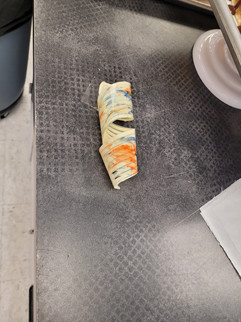

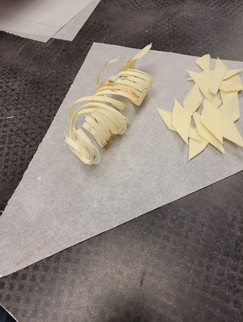
The white chocolate diamonds and spirals were then added to the glazed opera cake.

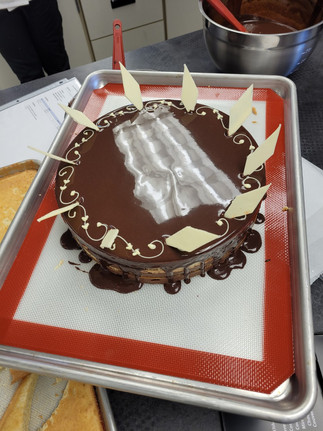

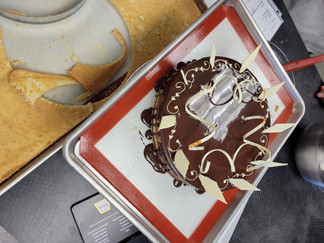





“A cake such as this deserves a brief explanation of its history, although it is slightly murky. Many claim that this cake dates back to1903, from pastry chef Louis Clichy who unveiled this cake at a Paris culinary exposition that year. He named it simply “Clichy Cake” with his surname penned in ganache across the top. Another French pastry shop, Dalloyau, popularized the cake (c.1955) and lays claim to it with a version called L’Opera, created in honor of the Paris opera. Also scribed on top in ganache is the word ‘opera’. Which sounds very Clichy-esque to me, but as one article on the subject noted: ‘history is written by the victors. So, Opera Cake it is.” (Baird, 2021)


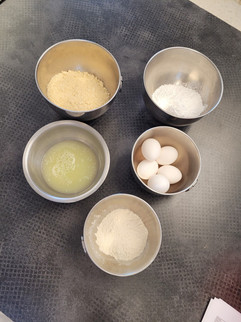
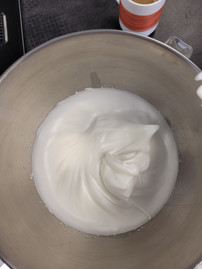
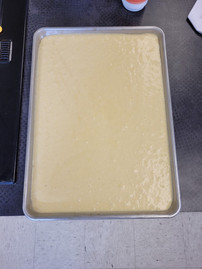
Evaluation: In the beginning of class, we made our own Joconde Sponge Cakes which included a beautiful whipped meringue which we folded into the batter, while waiting on Marie to arrive. My lab group managed to time it perfectly and pulled ours out of the oven just before our guest arrived. We made the mistake of not letting it cool enough before removing the silicone mat, so the edges broke.











Conclusions: Once Marie’s demonstration was complete, we set about the task of building miniature versions of the Opera Cake using the Joconde we made at the start of lab.
After cutting through the middle with a fork, you can see that we had a heavier hand when applying the espresso syrup on the bottom layer.


However, I am impressed with the stability of the cake and the overall appearance of the finished product. One of my lab partners finished our cake by adding the beautiful Opera Glaze and sliced strawberries. Trust me when I say, this cake is just as tasty as it looks. It was almost too pretty to eat, but who am I to pass up a coffee lovers dream in the form of dessert. 😉

References
“Central.” https://central129coosa.com/home. 2022.
“Classic Opera Cake.” Heather Baird. https://www.sprinklebakes.com/2021/01/classic-opera-cake.html. 2021.


Comments