Week 2: Gravlax & Sesame Ginger Slaw
- kelafoy
- Aug 23, 2021
- 6 min read
Updated: Aug 30, 2021
Introduction
This week our culinary module is Garde-Manger, Cured & Smoked Meats.
Method of Cookery: “Garde Manger is a cook who specializes in preparation of cold foods such as meats, fish, and salads.”(Merriam-Webster, 2021)
Prior Knowledge of the Dish: I have no knowledge of Garde-Manger or how to prepare a dish in such a way. Before conducting research for this week’s recipes, I assumed the term had something to do with knife skills and how to fashion vegetables into art. BOY WAS I WRONG! I must laugh at my pure ignorance sometimes. Even after 20+ years of working in restaurants I still have so many things to learn.
As for smoking meats, I have some personal experience in this area. Not professionally, but I like to smoke meats and vegetables at home. I like the idea of trying to use an indoor smoker to see if I can smoke certain elements of a dish, without having everything taste smokey.
Learning Objectives:
Understand the history and purpose of cured and smoked foods
Identify the crucial ingredients for preserving foods
Explain the function of salt in osmosis, dehydration, and fermentation
Describe the role of curing salts in preserving foods
Discuss seasoning and flavoring options for cured and smoked foods
Compare the effects of dry cures and brines
Describe the evolution of brining from a preservation technique to a flavoring technique
Evaluate cold smoking and hot smoking alternatives
Explain the technique of air-drying
Describe the method of preservation in fat
Background Information
Origin & History:
Cured & Smoked Meats… “The origin of meat curing can be traced back to the third century BC, when Cato recorded careful instructions for the dry curing of hams. As early as 3000 BC in Mesopotamia, cooked meats and fish were preserved in sesame oil and dried, salted meat and fish were part of the Sumerian diet. The early processed meat products were prepared with one purpose in mind: their preservation for use in times of scarcity. During 900 BC, salt was being produced in ‘salt gardens’ in Greece and dry salt curing and smoking of meat were well established. The Romans in 200 BC learned the use of salt from the Greeks and besides curing fish, the Romans preserved various types of meat, such as pork with pickles containing salt and other ingredients. It was during this time that the reddening effect of salting was noted. By medieval times, treating meat with salt, saltpeter and smoke was common place and saltpeter’s effect to ‘fix’ the red color was well recognized.” (History of Meat, 2013)
Gravlax… is “a Scandinavian dish consisting of salmon marinated with dill. It originated as a pre-refrigeration method of preservation in which the raw fish was sprinkled with salt and dill and then buried in the ground… for a period varying from a few days to... as much as three months.” (Oxford, 2021)
Methods Used:
Gravlax…“The modern way to prepare gravlax is to keep the fish marinating in the fridge for a maximum of three days; it is then scraped free of its salt and dill, sliced thinly, and served in the manner of smoked salmon, usually with a mustard sauce (gravlaxsas).” (Oxford, 2021)
Smoked & Cured Meat… the smoking technique involves hanging the meat or placing it on racks in a chamber designed to contain the smoke. “Cured meat is preserved through the salt primarily that inhibits meat creating an inhospitable environment for unwanted bacteria. Smoked meat can be cooked through a low heat or cured then cold smoked to dry the meat, cold smoking is not cooking but drying.” (Mueller, 2020)
References
Auburn University Hospitality Management. HOSP 3450 / NTRI 4970, Advanced Culinary Arts, https://auburn.instructure.com/courses/1385357/pages/week-2-overview?module_item_id=19964094. Fall 2021
“Difference Between Cured Meat vs. Smoked Meat.” EatCuredMeat.com, Tom Mueller, https://eatcuredmeat.com/difference-between-cured-meat-vs-smoked-meat/. 2020.
“Garde-manger.” Merriam-Webster.com Dictionary, Merriam-Webster, https://www.merriam-webster.com/dictionary/garde-manger. Accessed 23 Aug. 2021.
“Gravlax Overview.” OxfordReference.com, Oxford University Press, https://www.oxfordreference.com/view/10.1093/oi/authority.20110803095904814. Accessed 23 Aug. 2021.
“History of Meat Curing Process.” https://foodprocessinghistory.blogspot.com/2013/05/history-of-meat-curing-process.html. Monday, May 6, 2013.
Dish Production Components
Recipes:

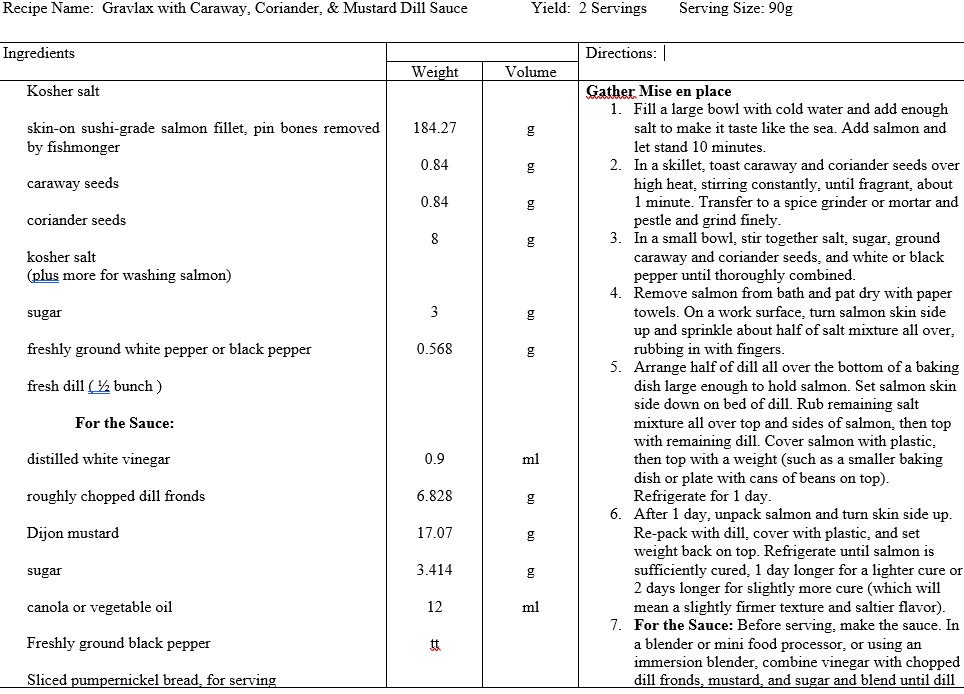
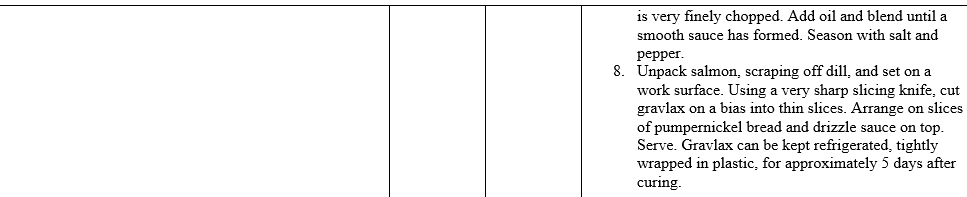

Plan of Work:
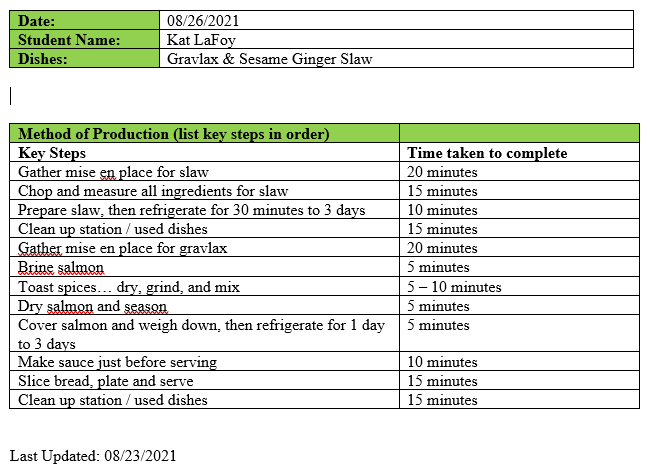
Plate Presentation:


Reflection & Summary of Results
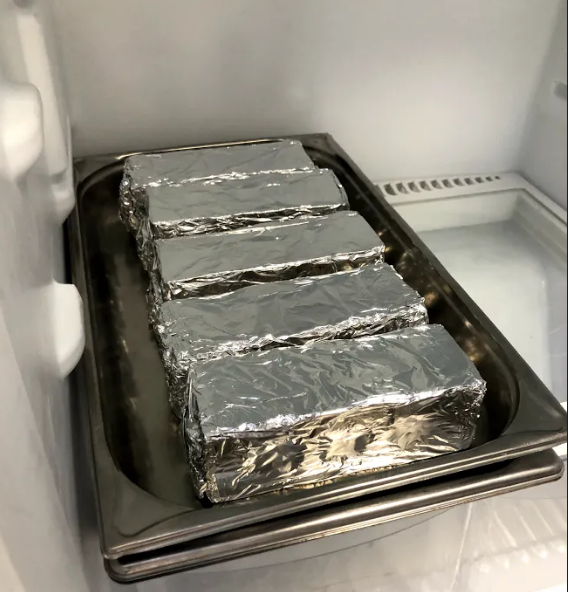
What Happened(?): We began the process of our #gravlax this week by brining a large salmon filet in a salt bath made to “taste like the ocean”, for about 10 minutes. While the salmon was bathing, we toasted ground coriander (we did not have the caraway on hand that the recipe calls for) and combined it with salt, sugar, white pepper, and fresh dill. We then removed the filet and patted it dry with paper towels, careful not to destroy the tender flesh. Once the filet was rid of excess water we spread the spice mixture over the outside of the filet, wrapped it tightly with cling wrap, placed small holes in the under-side of the filet (to continue to release moisture as it cures), and placed it skin-side down in a hotel pan with a perforated pan included for draining purposes. Placing another hotel pan on top of the filet and adding wrapped bricks as weights will help the salmon to continue releasing moisture and aid in the curing process. The salmon will be removed from the cure in 4 days, be washed, and rewrapped to hold until we can continue in lab next week. So…TO BE CONTIUED. 😊
On another note, we had the joy of smoking many different flavors and textures this week, using a Breville smoking gun. We smoked cashews to add depth to the flavor of our sesame ginger slaw. We split apart and created our own flavor profiles for smoked shrimp. A really fun idea that was had was to try whipping eggs whites and smoking them. Let me tell you...IT WAS AWESOME!!! Check out the cool action shots below and then keep reading along to find out what the outcome was of each dish and how it tasted.


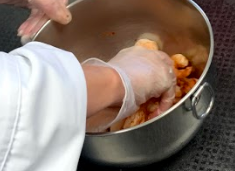


Some classmates chose a hot smoked shrimp and it turned out beautifully.

Now...let's start at the beginning and see what we can make of each part of the plate.
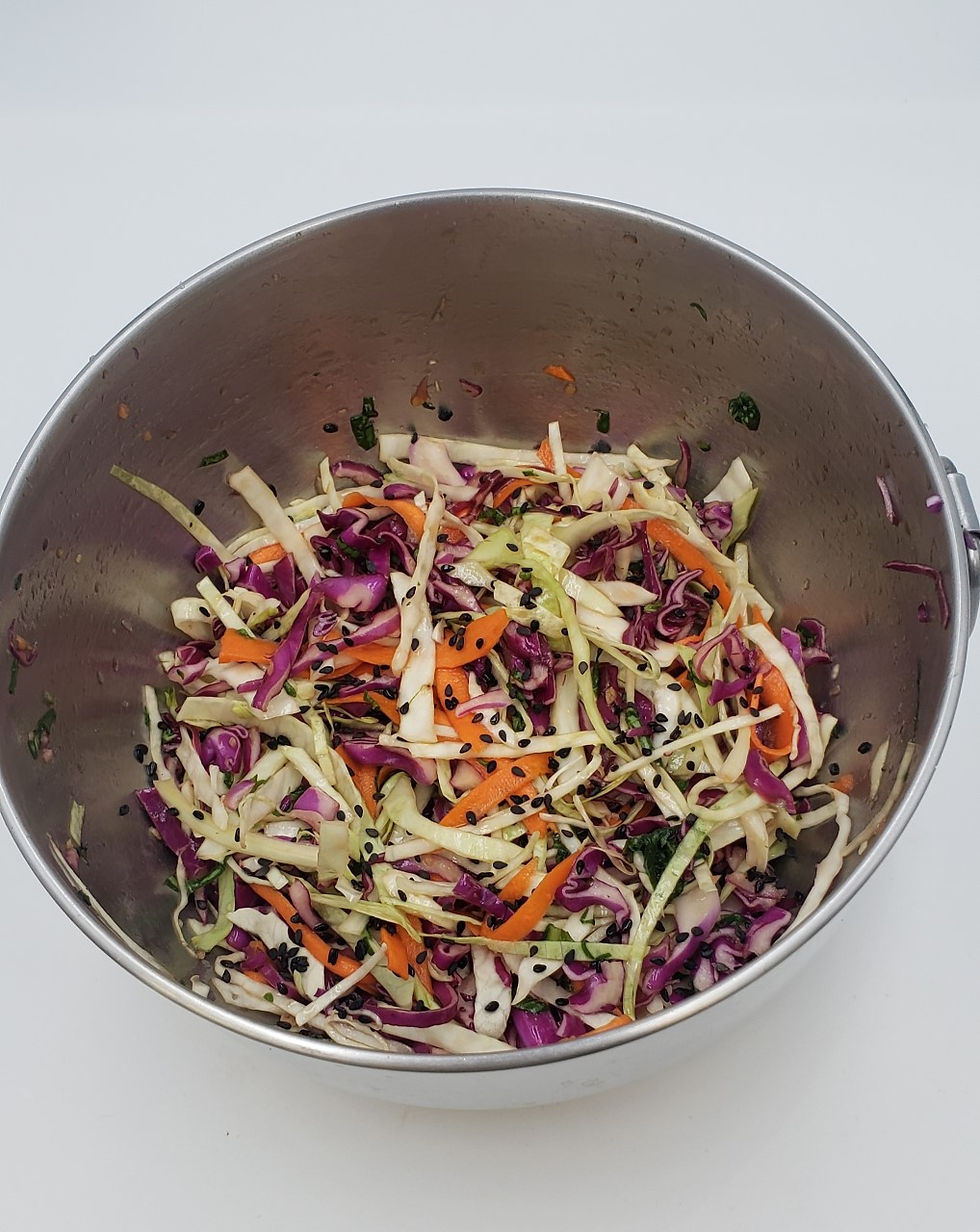
The sesame ginger slaw was done three different ways. I chose to hand cut my cabbage and shaved carrots. I thought this may help save the integrity of the leaves a little and keep their crunch. This didn't seem to help, and after one hour of refrigeration the slaw turned out a little soggy and over salted. As for the shrimp, we all had to use precooked shrimp as a base since it was the only shrimp available to us. I chose to marinate pre-cooked / brined shrimp in a mixture of ground sage, paprika, ground ancho chile, white pepper, and white wine vinegar. The shrimp was then cold smoked and allowed to rest for approximately 10 minutes in the smoke cocoon before plating. The shrimp was rubbery which is somewhat expected with it being precooked. When thinking of flavor compliments and plating ideas we landed on smoked tomatoes with gruyere cheese on fresh made flat bread. Honestly, this was my favorite part of the dish. The smokiness of the tomatoes was complimented by the fresh acidic sweetness of the juice and the saltiness of the gruyere. Add in the doughy firmness of the warm flatbread to give body to the bite and it's a winner in my book.

Our highlight of this week's meal was the whipped egg whites. They were whipped into a meringue texture then placed in a smoke cocoon for about 20 minutes. The difference before and after was a bowl of yumminess that is hard to describe...but here we go... 😊. You know when you go camping and get that gooey toasted marshmallow that ALMOST caught on fire...or when you left that sweet canned yam soufflé in the oven a touch too long at Thanksgiving that year you were too tired to buy real sweet potatoes because of the extra work, and the marshmallow cream burned on top? That's the AMAZING result of smoking whipped egg whites. It becomes a smore in a bowl and should be prepackaged and sold in stores. We made toasted smoked meringues and plated some beautiful examples. If you ever get the chance, I highly recommend you create some #smokedeggwhites of your own.

Evaluation:
What Worked & What Didn't?
Hand cutting the slaw did not seem to help the slaw retain its crunchy texture. It was still fairly crisp; however, I feel like it slowly seeped water from the cabbage into the bowl the longer it sat. If I had shredded the cabbage using a food processor it may have removed more of the excess water. I think either way I should allow the cabbage to sit in a colander to drain before adding the dressing to it. The dressing was over salted, but that is easily remedied by reducing the amount of salt by half. Reducing the salt will also help retain some of the water rather than losing it to the bottom of the bowl.
The shrimp was seasoned well. I think the hot smoke method would have enhanced the flavors better. Studies have been done stating that we process the flavor of food differently when the temperature of the food is warmer.

(Heller, 2005)
I don't know that I would do anything to change the egg whites. They were a pleasant addition to an already tasty dish.


Conclusions:
All together I think the flavor profiles we chose paired very well. I may alter the slaw next time and take out the sesame oil. It could be a bit overpowering and take over the rest of the dish. Heating the shrimp will also elevate the plate a little. Moving between warm shrimp and cool, crisp slaw gives variety to the textures in your mouth and helps improve your palate. After all..."The only way to reset your palate is to constantly bombard it with new flavors and textures." (Chef Works, 2014)
References
“Food Temperature Affects Tastes, Reveal Scientists.” Beveragedaily.com, Lorraine Heller, https://www.beveragedaily.com/Article/2005/12/19/Food-temperature-affects-taste-reveal-scientists?utm_source=copyright&utm_medium=OnSite&utm_campaign=copyright. 19 December 2005. Updated 19 July 2008.
“Simple Ways to Improve Your Palate.” Blog.chefworks.com, Chef Works, https://blog.chefworks.com/uniforms/simple-ways-to-improve-your-palate/. 22 May 2014.


Comments