Week 6: France
- kelafoy
- Sep 19, 2022
- 8 min read
Updated: Sep 25, 2022
Introduction
“French cooking is considered by many to be the most prestigious and respectable cuisine in the world. With its formal techniques, emphasis on fresh ingredients and simple flavors, pride in presentation, and rich and colorful history, French cuisine truly has come to rule the world, laying the foundations for many other styles and specialties.” (Escoffier, 2022)
Method of Cookery:
“France hasn’t always been keen on garlic, mushrooms, and truffles. Before the fifteenth century, seasonings and decorations were used to disguise food that had spoiled. France had what many today consider peasant food; it was simple fare without extravagant adornment.
In the mid-fifteenth century, Catherine de Medici of Italy moved to France to marry the future King Henri II, bringing with her Florentine-educated cooks and a sense of creative drama and manners. In the coming years, French cuisine turned into a magical art of beautiful presentation and innovative flavors.
French cuisine is a unique, cultural experience that melds flavorful, seasonal foods with beauty, leisure, and precise preparation. Making and savoring French food is an art that might take a lifetime to master yet requires that time stands still to appreciate its splendor.” (Franklin, 2022)
Prior Knowledge of the Dish:
I have some experience with variations of French cuisine. A large portion of my family resides in various parts of Louisiana where a lot of Cajun French cooking takes place. This isn’t identical to French cooking, but Cajun cooking shares a lot of similarities. In addition to similar cooking techniques, Louisiana uses many of the same French breads and pastries such as baguettes and beignets. Rice is a major staple in Cajun cooking but the French tend to accompany their entrees with breads, salads, or French fries.
Learning Objectives:
1. Introduce the fascinating history of France, its geography, cultural influences, and climate.
2. Reveal how and why France became the world’s most revered and respected culinary capital.
3. Introduce French culinary culture and dining etiquette, important techniques that French chefs have codified, and the dishes of the twelve culinary regions of France.
4. Identify important French foods, flavor foundations, seasoning devices, and favored cooking techniques.
5. Offer recipes for some of the important dishes of regional France.
Background Information
Origin & History: “French cuisine is a style of cooking derived from the nation of France. It evolved through centuries of social and political change. The Middle Ages heralded in lavish banquets among the upper classes with ornate, heavily seasoned food while the era of the French Revolution saw a move toward fewer spices and a more liberal use of herbs. More refined techniques for preparing French food developed with Marie-Antoine Carême, famed chef to Napoleon Bonaparte. French cuisine was more fully developed in the late nineteenth century by Georges Auguste Escoffier and became what is now referred to as haute cuisine. Escoffier's major treatise on French cooking (Le Guide Culinaire), however, left out much of the regional character found in the provinces of France. The move to an appreciation of provincial French food began with the Michelin Guide (Le Guide Michelin) and the trend to gastro-tourism during the twentieth century.” (Encyclopedia, 2022)
“Francois Pierre La Varenne published the first French cookbook in 1651 titled Le Cuisinier Francois. This inspired many chefs to record their work. The French Revolution in 1789 further helped to spread the study of cooking since it shattered the occupational restrictions established by the government. Additionally, more and more French people began cooking for themselves. Later, French cuisine expanded beyond France’s borders, and chefs from around the world studied these published guides. As the French colonized other countries – including parts of Asia, Africa, North America, and the Caribbean – throughout the 1700s and 1800s, they spread their culinary knowledge and cooking techniques.” (Escoffier, 2022)
Methods Used:
“There are numerous complicated tricks that French chefs employ to get their famous cuisine to look and taste just so. The art of French cooking is taught step by step, meanwhile interweaving skills, to compose a dish.
One key to French cooking is to learn the basic cooking methods. When one technique is mastered, another can follow. The cooking methods can include flambéing, sautéing, poaching, broiling, grilling, braising, and baking.
Another important component is knife skills. When you have formal training, you will learn the difference between a julienne, a batonet, and a brunoise.” (Franklin, 2020)
“Saute
Sauteeing is a technique of cooking ingredients in a pan coated with olive oil or butter over medium to high heat. To sauter means “to jump” in French, which is what ingredients do in a hot pan. One classic dish that relies on this technique is lamb chasseur.
Braise
Braising is a combination cooking method used to cook meat or vegetables in a covered pot over low heat until the products are tender. Chefs typically sear the surface of meat or vegetables at high temperatures then lower the heat. Next, the ingredients slowly cook in fat, stock, or wine to produce complex flavors along with soft and tender bites.
Confit
To confit an ingredient requires salting and cooking the product in fat. Traditionally, this technique was used to preserve meat. Duck confit is a classic French dish that uses this method. However, you can also confit many vegetables such as garlic or potatoes!
Flambe
Flambe involves the use of flammable alcohol to make desserts such as cherries jubilee. When the alcohol is set on fire or flambeed, it burns the alcohol away in mere seconds while leaving the aroma of the liquor’s main flavor. For many years, restaurants would flambé various dishes tableside to highlight both the technique and enhance the dining experience for their guests!” (Escoffier, 2022)
Dish Variations:
“The French will usually cook and prepare dishes local to their region. This no way means they are parochial; the French have a real sense of terroir which is why rural French cooking is alive and kicking in France. In metropolitan France, they are likely to sample a wide array of regional and national dishes. This is true in many cities around the world where the residents are multi-cultural or comprise different ethnicities.
Typical French foods rely heavily on local products. Fresh apples, berries, haricot verts, leeks, mushrooms, various squash, and stone fruits are among the most commonly used products. Poultry, beef, lamb, and veal are readily available year-round. Game meat is especially popular and abundant during the hunting season that runs from early autumn to February. No matter the region, France has an abundance of artisanal cheese and wine.
Southern France features the rich, sophisticated flavors of mushrooms and duck as well as the dramatic herbs, tomatoes, and olives borrowed from neighboring Mediterranean cuisines. Northern France also showcases a remarkable assortment of tastes, focusing heavily on farmhouse-style specialties using apples, dairy, pork, potatoes, sausage, and beer.” (Franklin, 2022)
References
“French Cooking: How And Why French Cuisine Came To Rule The World.” Escoffier. https://www.escoffier.edu/blog/world-food-drink/french-cooking-how-and-why-french-cuisine-came-to-rule-the-world/. 12 May 2022.
“French Cooking Basics. What It Takes to Be a French Cook.” Rebecca Franklin. https://www.thespruceeats.com/basics-of-french-cooking-1375352#:~:text=The%20cooking%20methods%20can%20include,a%20batonet%2C%20and%20a%20brunoise. 17 September 2020.
“French cuisine.” The World Encyclopedia. https://www.newworldencyclopedia.org/entry/French_cuisine. 2022.
“Introduction to French Food and Cooking.” Rebecca Franklin. https://www.thespruceeats.com/introduction-to-french-food-and-cooking-1375348. 09 April 2022.
Dish Production Components
Recipes:




Plan of Work:

Sources:


Reflection & Summary of Results
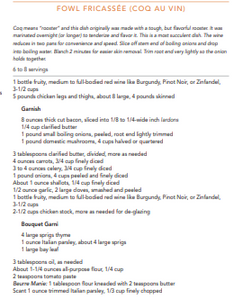
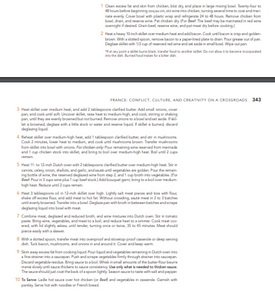
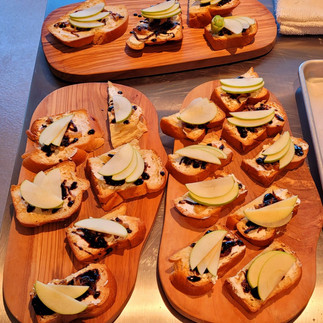
What Happened(?): This week was kind of a bummer yet kind of fun. I was really looking forward to the foie gras since I have never worked with it before, nor have I ever tried it. Unfortunately, the foie wasn’t delivered in time for our lab Thursday, so we were unable to work on it. We still had the coq au vin and cheese soufflé to work with, so the day wasn’t a total bust. Chef Tom in the amazing new restaurant 1856, which is part of our new teaching facility at the Tony & Libba Rane Culinary Science Center, was kind enough to allow us to try the Foie Apple created by our Chef in Residence (Chef Tyler Lyne). It got slightly butchered when it was being handled in the class, but you can see the basis of what it should look like. The presentation is much nicer in 1856.


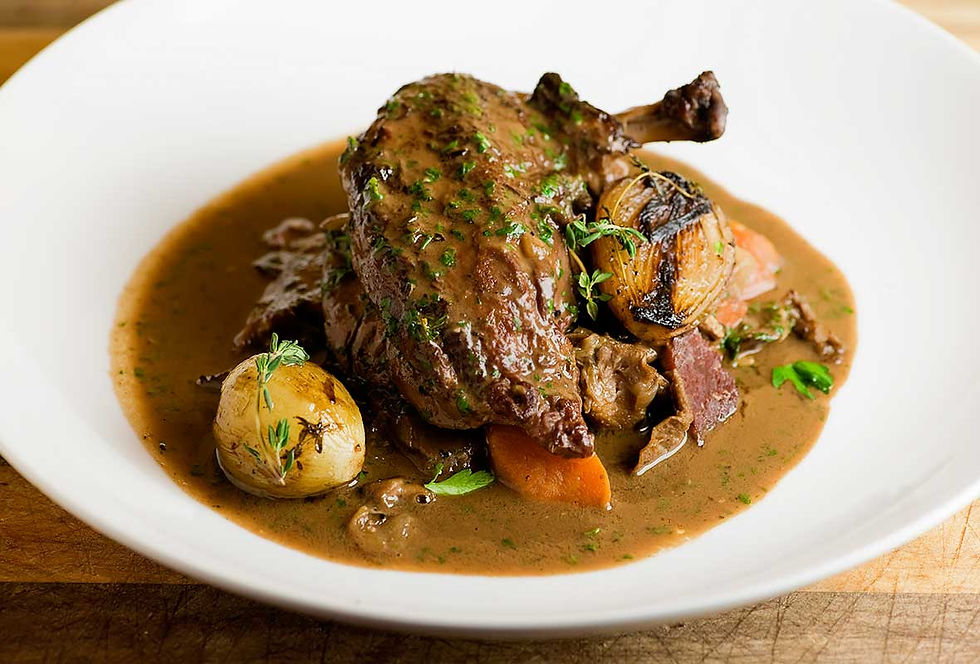
Evaluation: Magen primarily worked on the coq au vin. It took longer to prep the vegetables than expected. I think in the end it came out wonderfully once everyone chipped in to help get the dish out on time.


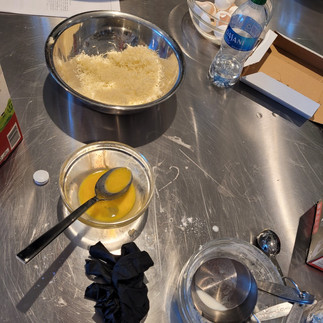
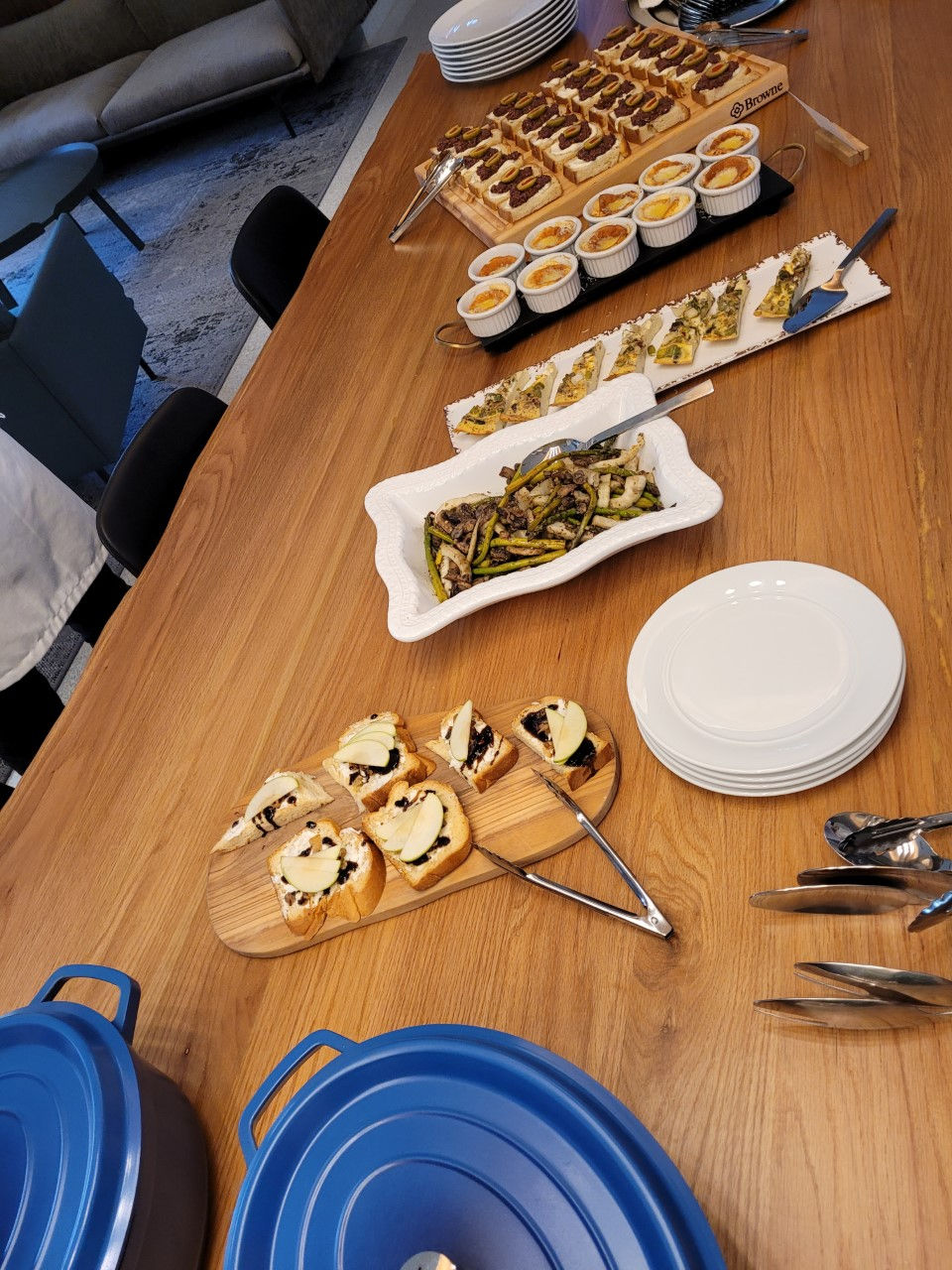
Sophia and Cameron made the cheese soufflé. They miniaturized them to stretch the soufflé a little further. This way we were able to feed more people by controlling the portions ourselves. I think they puffed beautifully. Based on my own personal knowledge, I’m thinking that they didn’t mix the egg mixture thoroughly enough into the cheese (mornay) base. Based on a New York Times article I found online, I’m pretty sure I’m correct. “Classic French cookbooks will tell you to fold the base and whites together gently. But if the base and whites do not form a homogeneous mixture, the souffle may rise unevenly and have pockets of egg white.” (Hesser, 2000)



Natasha and Céline made a version of Potatoes Au Gratin that…in my opinion…was the tastiest dish on the table. Being a down-home southerner, I’m very much a meat and potatoes kind of girl. 😉


Will and Natalie made a nice confiture et pain. They toasted brioche loaf slices and topped them with goat cheese, balsamic fig jam, caramelized onions, and green apple. They made a special piece for me with no onion and the flavor profile was phenomenal. Definitely my second favorite dish of the day. 😊 It was a little sweeter than I expected, but the onion I didn’t have probably counteracted that. Some bacon lardons on top would have complimented nicely as well.



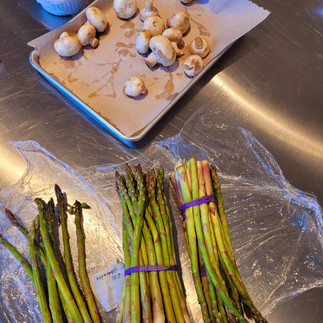
Conclusions: I liked being able to create dishes from our own minds this week. We had some produce that needed to be used so Chef Ana gave us free reign to make some things we thought would fit into the French theme. I roasted some fennel, asparagus, and mushrooms in the oven, and Cameron used some of them to make a beautiful quiche.




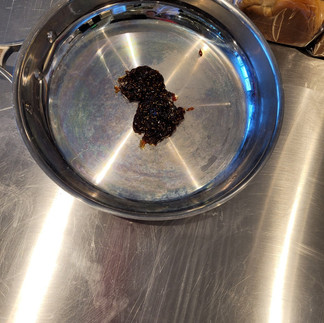
I decided to go with Tapenade hors d'oeuvres. I wanted to use the goat cheese but left it to Will and Natalie for use so neither of us would have to compromise our dish by only using half. Instead, I built my tapenade using purple Kalamata olives as well as Halkidiki olives (also known as donkey olives due to their size), both Greek in origin. Kalamata olives get their flavor and color from ripening longer on the vine than green olives. Green olives tend to be firmer in texture and have a slightly more bitter taste, whereas reddish-purple and black olives are sweeter. I combined the pureed olives with minced garlic, honey, and fresh lemon juice and made a well-balanced tapenade if I do say so myself. I really needed to add capers, but we didn’t have any in the lab. I toasted slices of brioche in the oven and put a heavy schmear of melted cream cheese across the top of each slice. I then added the tapenade and garnished with half a Halkidiki olive and plated on a wood block.

They were very popular and seemed to attract faculty and guests like Dr. Martin. He enjoyed two of them that were extra before the platter even made it to the table. 😊

I think I should have toasted the bread a little longer. The moisture from the warm cream cheese softened the bread more quickly than I anticipated. In the end, we learned a lot this week and enjoyed being able to create rather than just follow recipes. It was a nice change of pace.
References
Culinary Residence 1856. https://auburn1856.com/. 2022.
“The Modern Souffle: Bastion of Strength.” Amanda Hesser. https://www.nytimes.com/2000/03/08/dining/the-modern-souffle-bastion-of-strength.html#:~:text=Classic%20French%20cookbooks%20will%20tell,have%20pockets%20of%20egg%20white. March 08, 2000.
Tony & Libba Rane Culinary Science Center. https://ranecenter.auburn.edu/hospitality/. 2022.
Comments